
- You are here:
-
Home

- Policy Briefs
Mediating from the margins: The role of intermediaries in facilitating participation in formal markets by poor producers and users
Repositioning electricity planning at the core: An evaluation of South Africa’s Integrated Resource Plan
Dr Neva Makgetla
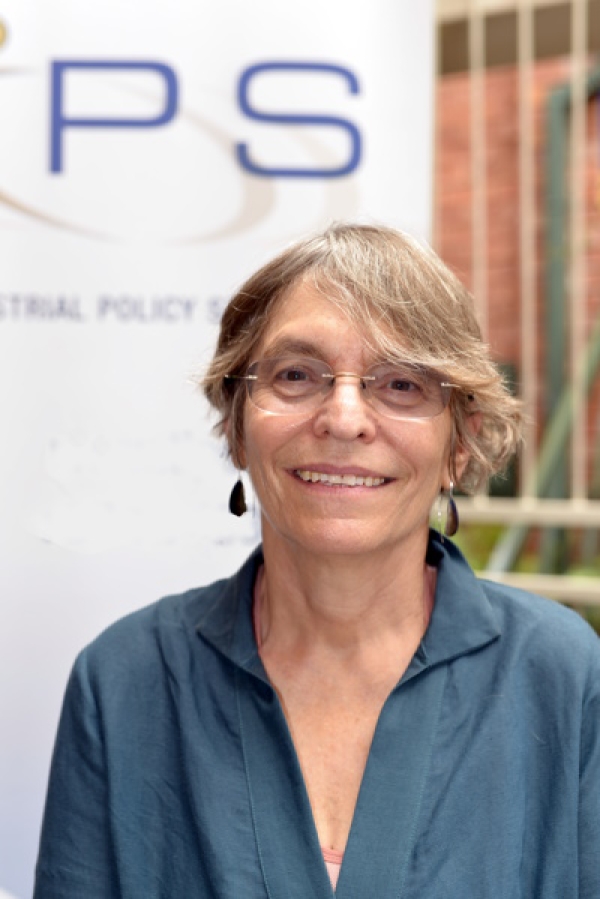
- Position Senior Economist
History

TIPS@25 and beyond: A celebration of 25 years of support for policy development through research and dialogue
This anniversary publication celebrates and reflects on TIPS and its 25 year history. TIPS, like the country, has evolved significantly over the past 25 years. It looks at the organisation's journey, the people involved over the years, as well as its current role and future challenges, with messages from board members and staff.
CHAPTERS INCLUDE:
1991-1995: The early years
1996-2002 The Trade and Industrial Policy Secretariat gets going
2003-2008: TIPS faces changing terrain
2009-2013: TIPS seeks to refocus to survive
2014-2021 Growth and consolidation
Download a copy or read online: TIPS@25 and beyond
What TIPS Does
TIPS’s central activities are economic research and analysis, dialogue facilitation on relevant economic issues, capacity building and project management. It undertakes research or projects either on a commissioned basis (funded by an external partner) or as in-house thought leadership (funded internally). A portion of TIPS’s core funding is provided by the Department of Trade and Industry.
TIPS research and analysis draws on its own as well as a network expertise in the fields of industrial development, trade, inequality, green economy, electricity and mining as well as a number of industry subsectors.
As part of its dialogue work TIPS organises regular Development Dialogue Seminars and the TIPS Annual Forum. Having built up experience of running over 15 economic conferences over the past 20 years, TIPS can also be contracted to organise economic conferences for other organisations.
As part of its capacity building work, TIPS runs over 10 training workshops for individuals and groups on economic related issues. These workshops draw on a number of experts in their field. TIPS co-facilitates the annual African Programme on Rethinking Development Economics (APORDE) programme, and co-hosts a number of seminars with APORDE.
TIPS’s main strengths are:
- Its technical capacity especially for economic analysis and research;
- Its understanding of the policy environment in government and its ability to facilitate dialogue on key economic issues at a high level within and outside of government;
- Its ability to provide research, analysis, dialogue and capacity building services under one roof in a continuous and seamless process.
This allows the organisation to assist partners and beneficiaries at all stages of a policy life cycle and to participate in forward-looking thinking and future agenda setting.
TIPS’s work is backed by support services that allow for flexible, high-quality administration of complex programme management, large rolling budgets and extensive monitoring, evaluation and reporting requirements. TIPS’s support processes have specific experience in dealing with governmental and donor agency contracting.
Partners
DTI - Department of Trade and Industry
Lorem ipsum dolor sit amet, consectetur adipiscing elit, sed do eiusmod tempor incididunt ut labore et dolore magna aliqua. Ut enim ad minim veniam, quis nostrud exercitation ullamco laboris nisi ut aliquip ex ea commodo consequat. Duis aute irure dolor in reprehenderit in voluptate velit esse cillum dolore eu fugiat nulla pariatur. Excepteur sint occaecat cupidatat non proident, sunt in culpa qui officia deserunt mollit anim id est laborum.
GTAC - government Technical Advisory Centre
Lorem ipsum dolor sit amet, consectetur adipiscing elit, sed do eiusmod tempor incididunt ut labore et dolore magna aliqua. Ut enim ad minim veniam, quis nostrud exercitation ullamco laboris nisi ut aliquip ex ea commodo consequat. Duis aute irure dolor in reprehenderit in voluptate velit esse cillum dolore eu fugiat nulla pariatur. Excepteur sint occaecat cupidatat non proident, sunt in culpa qui officia deserunt mollit anim id est laborum.
City of Johannesburg
Lorem ipsum dolor sit amet, consectetur adipiscing elit, sed do eiusmod tempor incididunt ut labore et dolore magna aliqua. Ut enim ad minim veniam, quis nostrud exercitation ullamco laboris nisi ut aliquip ex ea commodo consequat. Duis aute irure dolor in reprehenderit in voluptate velit esse cillum dolore eu fugiat nulla pariatur. Excepteur sint occaecat cupidatat non proident, sunt in culpa qui officia deserunt mollit anim id est laborum.
CWP Annual Report 2010/11
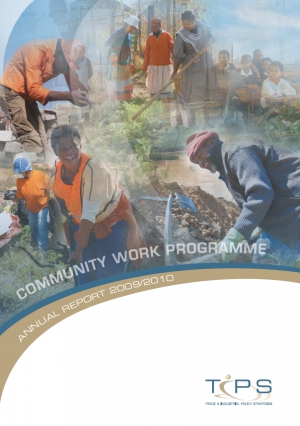
The Community Work Programme (CWP) has been based in the Department of Cooperative Governance (DCoG) since April 2010. In the 12 months to March 2011, 89 689 people participated in the programme putting in 5 449 376 workdays. A total of R307 million was paid in wages, and the CWP had a massive impact on communities in 56 sites all over South Africa.
As well as these nationally-funded sites, six sites were funded by the Gauteng Provincial Government, with a further 7 164 participants. The Employment Creation Fund of the Department of Trade and Industry (the dti) also funded the CWP Watershed Services River Cleaning Project, employing an additional 2 326 people. This brings total participation in the CWP to more than 99 000.
The CWP was started as a pilot project in late 2007. It was initiated as part of a strategy process commissioned by the South African Presidency and located in Trade and Industrial Strategy Projects (TIPS). This strategy process culminated with a framework document, Second Economy Strategy: Addressing Inequality and Economic Marginalisation, approved by Cabinet in January 2009. It was also included in full in the final report of AsgiSA (Accelerated and Shared Growth Initiative for South Africa) in April 2009.
This strategy framework emphasises the need for structural change to deliver sustainable jobs in the South African economy – but it also recognises that this will take time, and that a complementary strategy is needed to enable economic participation by those excluded from employment. In this context, the strategy framework calls for the adaptation of the concept of a minimum employment guarantee to South African conditions –with the CWP as an example of how this could be done.
The CWP pilot programme was supported by The Presidency and the Department of Social Development, which constituted a National Steering Committee to provide strategic oversight to the programme. The National Steering Committee was expanded in 2009 to include representatives from the Department of Public Works, DCoG and National Treasury. The pilot phase and further roll-out of the programme was project managed by TIPS in partnership with two Implementing Agents, Seriti Institute and Teba Development.
Much of the focus of 2010/2011 has been on institutionalising the different elements of the programme in DCoG.
Partners and Associate Organisations
While TIPS’s core work is for government departments, it works with a wide variety of clients, beneficiaries and partners in the public sector, the private sector, the trade union movement, academia and the donor community. It also works with various organisations beyond the continent, and has working relationships with a network of local and international academics and experts.
{slider SOUTH AFRICAN GOVERNMENT}
City of Johannesburg - www.joburg.org.za
Cooperative Governance and Traditional Affairs - www.cogta.gov.za
Competition Commission South Africa - www.compcom.co.za
Department of Environmental Affairs - www.environment.gov.za
Department of Planning, Monitoring and Evaluation in the Presidency - www.dpme.gov.za
Department of Public Enterprises - www.dpe.gov.za
Department of Science and Technology - www.dst.gov.za
Department of Trade and Industry (the dti) - www.thedti.gov.za
Economic Development Department – www.economic.gov.za
Government Technical Advisory Centre - www.gtac.gov.za
National Treasury - www.treasury.gov.za
{slider INTERNATIONAL ORGANISATIONS}
Centre for Economic Policy Research (CEPR) - http://cepr.org
Global Green Growth Institute (GGGI) - http://gggi.org
International Labour Organization (ILO) – www.ilo/org
Organisation for Economic Co-operation and Development (OECD) - www.oecd.org
Overseas Development Institute (ODI) - www.odi.org
Partnership for Economic Policy (PEP) - www.pep-net.org
School of Oriental and African Studies, University of London (SOAS) - www.soas.ac.uk
United Nations Conference for Trade and Development (UNCTAD) - http://unctad.org
United Nations Development Programme (UNDP) - www.undp.org
United Nations University World Institute for Development Economics Research (UNU-WIDER) - www.wider.unu.edu
{slider REGIONAL ORGANISATIONS}
African Competition Forum - www.africancompetitionforum.org
Southern African Customs Union (SACU) (Secretariat and Member States) - www.sacu.int
Southern African Development Community (SADC) Secretariat (Regional Trade) - www.sadc.int
Southern African Development Network Partners - including the University of Mauritius (UoM) and Borswana Institute for Development Policy Analysis (BIDPA) and the African Economic Research Consortium (AERC)
{slider INSTITUTIONS, UNIVERSITIES AND ORGANISATIONS}
TIPS works with a range of institutions, universities and research organisations
Development Bank of Southern Africa (DBSA) – www.dbsa.org
Financial Intelligence Centre (FIC) - www.fic.gov.za
Industrial Development Corporation (IDC) – www.idc.co.za
Manufacturing Circle - www.manufacturingcircle.co.za
National Economic Development and Labour Council (NEDLAC) - new.nedlac.org.za
North West University (Economics) - www.nwu.ac.za
Public affairs Research Institute (PARI) - http://pari.org.za
Small Enterprise Finance Agency (SEFA) – www.sefa.org.za
tralac - www.tralac.org
University of Johannesburg (Centre for Competition Regulation and Economic Development, CCRED, and Economics Department)
www.uj.ac.za/faculties/fefs/economics
University of the Witwatersrand (Economics Department, CSID, CLEAR, Development Studies) - www.wits-ac.za
University of Cape Town (DPRU, Economics Department, REDI 3x3) – www.uct.ac.za
University of KwaZulu-Natal (Economics) - economics.ukzn.ac.za
{slider CURRENT AND PAST DONORS}
AusAID/Department of Foreign Affairs and Trade - http://dfat.gov.au/aid/Pages/australias-aid-program.aspx
British High Commission (BHC) - www.gov.uk/government/world/organisations/british-high-commission-pretoria
Department for International Development (DFID) - https://www.gov.uk/government/organisations/department-for-international-development
European Union (EU) - http://europa.eu/index_en.htm
GIZ - https://www.giz.de
International Development Research Centre (IDRC) - www.idrc.ca
USAID - www.usaid.gov
The Provincial Economic Intelligence Unit
- Year 2003
Organising Economic Conferences
As part of its dialogue work TIPS organises regular Development Dialogue Seminars and the TIPS Annual Forum. Having built up experience of running more than 15 economic conferences over the past 20 years, TIPS can also be contracted to organise economic conferencesfor other organisations.
Services provided include:
- Co-ordinating call for papers and registration
- Designing invitation and name badges
- Sourcing venues
- Meeting with service providers and negotiating rates
- Sourcing service providers for translations, equipment, entertainment, printing, décor, promotional and corporate gifts
- Selecting menus
- Arranging theme dinners
- Organising visas
- Arranging international and local travel logistics
- Organising tours and site visits
Experience
Conferences organised by the TIPS Event Management Team include:
- ERLN Conference 2016: Economic Development for Employment: Sub-national Strategies, November 2016. Hosted by the Government Technical Advisory Centre and the Economies of Regions Learning Network (ERLN) in partnership with the University of Johannesburg.
- ERLN Conference 2015: Economic Development at the Sub-National Level, October 2015. Hosted by the Government Technical Advisory Centre and the Economies of Regions Learning Network (ERLN) in partnership with the University of the Witwatersrand’s Development Studies Programme.
- Manufacturing Led Growth for Employment & Equality, May 2014. Hosted by the South African Economic Development Department, Department of Trade and Industry and Department of Performance Monitoring and Evaluation, in partnership with the European Union Delegation to South Africa.
- Project managed and coordinated the Partnership for Economic Policy (PEP) Conference: 10th General Meeting in South Africa, May, 2013.
- UNU WIDER, GAPP Technical Workshop April, 2013 (Held at TIPS for client)
- Department of Public Enterprises Supplier Development Summit, March, 2013 (Joint co-ordinator)
- Green Economy Workshop in Tanzania, March, 2013 (Joint co-ordinator with IDRC at Southern Sun in Dar es Salaam)
- South African Economic Regulators Conference, August, 2012 (at Southern Sun OR Tambo)
- Geographical Indicators Workshop, February 2012 (Joint co-ordination with Foreign and Commonwealth Office and the Department of Trade and Industry)
- Community Work Programme:
- Leadership Course
- Financial Workshop
- Inception Workshop
- Improving Competitiveness for Job Creation: Technology, Access to Finance and Industrial Policy Conference, October 27, 2011 (by TIPS and World Bank at the Development Bank of Southern Africa)
Myriam Velia
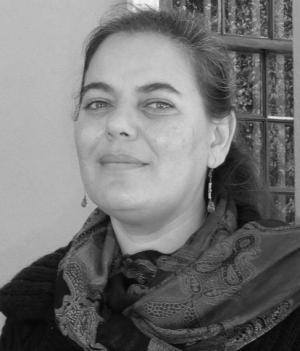
- Position Research Fellow
Planning systems to support the challenges of rapidly growing cities: Lessons from Mumbai
- Date Wednesday, 14 October 2015
- Venue TIPS Boardroom, 227 Lange St, Nieuw Muckleneuk, Pretoria
- Main Speakers UMA ADUSUMILLA