
- You are here:
-
Home

-
Economic Data
-
The Real Economy Bulletin
- Janet Wilhelm
Janet Wilhelm
Unpacking South Africa's Road to Building Back Better, Fairer and Greener: South Africa's recovery and stimulus package by global standards
TIPS, in collaboration with Green Economy Coalition, is hosting the second of four Green Recovery Dialogues webinars: Unpacking South Africa's Road to Building Back Better, Fairer and Greener - The EU’s Green New Deal and its implications for South Africa. Wednesday 6 April 10:00. Register online: .
Unpacking South Africa's Road to Building Back Better, Fairer and Greener: South Africa's recovery and stimulus package by global standards
SME Green Economy I-Go Initiative Project (Mbali Moroe: Project Manager, National Cleaner Production Centre of South Africa)
Green Economy Tracker
Online at Green Economy Tracker:
Media
Press release: Is South Africa on track in terms of its Green Economy Recovery objectives
Article: South Africa has strong green economy policies, but implementation a challenge (Marleny Arnoldi, Engineering News 17 February 2021)
This webinar aims to unpack South Africa's recovery efforts from a green economy perspective. It will notably feature the Green Economy Tracker developed by the Green Economy Coalition. It is the first of a series of four events in 2022 that will discuss South Africa's road to building back better, fairer and greener. Stay tuned and be part of South Africa's green recovery!
Programme
- Gaylor Montmasson-Clair, Senior Economist, Trade & Industrial Policy Strategies (TIPS)
14:30 - 14:50 Tracking South Africa's road to a green recovery
for Economic Justice (IEJ)
National Cleaner Production Centre of South Africa (NCPC-SA)
About the facilitator

Pacting season needs to bear fruit for longer than a year
Business Day - 31 January 2022 by Neva Makgetla (TIPS Senior Economist)
Engineering News - 31 January 2021 by Marleny Arnoldi
IISD and TIPS webinar: South Africa's Energy Fiscal Policies
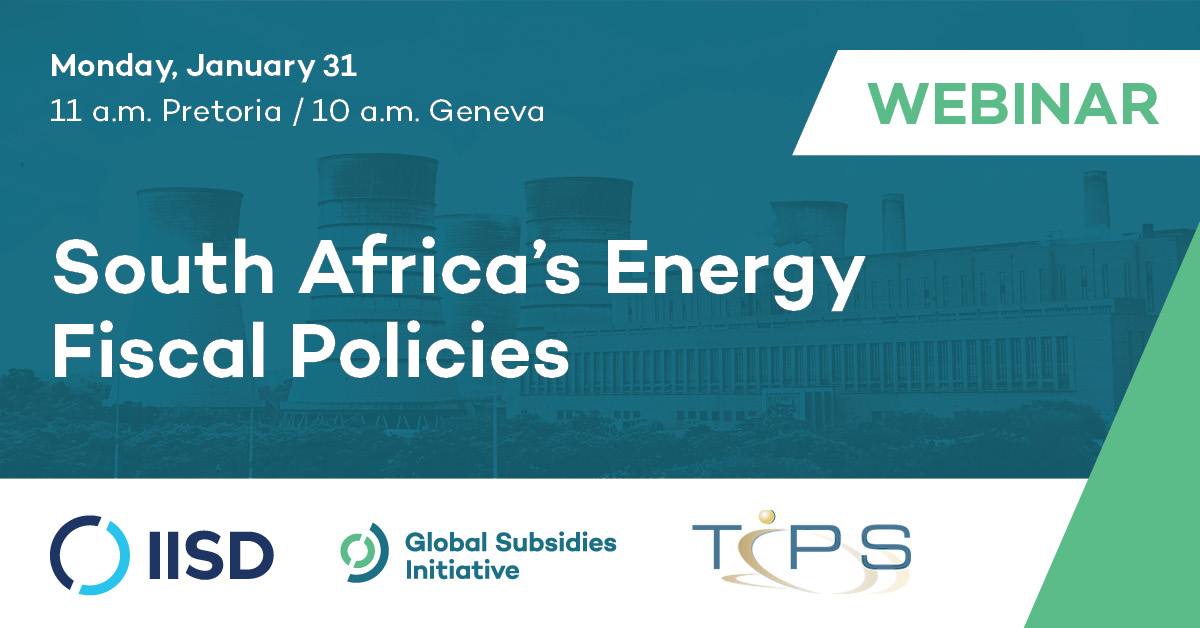
Download the report here: https://www.iisd.org/publications/south-africa-energy-subsidies
Watch the video here: https://youtu.be/lIII0Tu7D-E
IISD and TIPS webinar: South Africa's Energy Fiscal Policies
<iframe width="560" height="315" src="/
" title="YouTube video player" frameborder="0" allow="accelerometer; autoplay; clipboard-write; encrypted-media; gyroscope; picture-in-picture" allowfullscreen></iframe>Overview
This webinar, organised in partnership with Trade and Industrial Policy Strategies (TIPS), will provide participants with a first look at findings from the International Institute for Sustainable Development (IISD) report South Africa's Energy Fiscal Policies: An inventory of subsidies, taxes and policies impacting the energy transition, presenting key takeaways and recommendations.
The report explores the extent to which South Africa's current energy fiscal policies are aligned with its goal to develop a robust domestic energy system that can provide low-carbon energy at a fair cost to all. It provides clear recommendations for the government to align its fiscal energy policies with its climate and energy objectives.
Through a panel discussion and a Q&A session, participants will be encouraged to engage in a debate on carbon tax, bailouts, and what international moves to phase out fossil fuel financing and oil and gas exploration mean for South Africa.
Key questions
- Exemptions to the carbon tax need to be removed - carbon tax needs to internalise the social and environmental cost of the energy system, but with practical considerations on the social impacts and the impact on Eskom's finances.
- Bailouts - although we cannot allow the energy system to fail, how do we make the sector sustainable and ensure that bailout funds are enabling a transition rather than inhibiting it?
- What do international moves around phasing out fossil fuel subsidies and oil and gas exploration mean for SA's energy sector?
- Is the tax system doing enough to take account of external costs in energy pricing?
AGENDA
| 11:00 | Welcome from the moderator Richard Bridle, Senior Policy Advisor, IISD |
| 11:05 | Opening remarks Sharlin Hemraj, Director: Environment and Fuel Taxes, National Treasury |
| 11:15 | Launching USD report "South Africa's Energy Fiscal Policies" Chido Muzondo, Policy Advisor, IISD |
| 11:25 | Panel discussion • Gaylor Montmasson-Clair, Senior Economist: Sustainable Growth, Trade and Industrial Policy Strategies • Jessie Burton, Senior Associate, E3G (Third Generation Environmentalism) |
| 12:25 | Q&A |
| 13:00 | Close |
Registration
Register online: https://us06web.zoom.us/webinar/register/WN_5yhGna3LQYicnioMFvzAHg
Mitigation options for South Africa's petrochemical value chain
This paper seeks to add to the discourse on climate change mitigation in the petrochemical industry in South Africa, through a broad evaluation of the mitigation interventions available. For the purposes of the analysis, the scope is confined to the base and performance chemicals that are produced from the petrochemicals complex and does not include liquid fuels. It presents an overview of the petrochemical value chain in South Africa and the climate challenges within the value chain. It then considers the current available mitigation measures in terms of their technological development, barriers and rollout in South Africa. The interventions include energy efficiency measures, which cover combined heat and power, carbon capture, and nitrogen oxide mitigation technologies. Feedstock substitution options are also considered, which relate to increasing the use of natural gas, biomaterials and green hydrogen. Circular economy interventions which relate to the recycling of plastic and rubber are also discussed. The benefits, risks and implementation requirements for various stakeholders are then explored.
This research is part of the Making Sense of Employment in South Africa's Just Energy Transition project. TIPS and the WWF South Africa, with the support of GIZ, are implementing an initiative to support policymaking for South Africa's just transition. This focuses on employment and the relevant challenges and opportunities in the country's just energy transition.
Related research
Policy Brief: Employment metrics in South Africa’s electricity value chains
Localisation can only work if closely watched and tuned
Business Day - 18 January 2022 by Neva Makgetla (TIPS Senior Economist)
European Green Deal: The Carbon Border Adjustment Mechanism and implications for South African and European Union trade
The Carbon Border Adjustment Mechanism (CBAM) is a headline policy initiative of the European Green Deal. One of the drivers of the CBAM is that carbon emissions should have a price, and the CBAM is intended to “align the carbon price on imports with that applicable within the EU”. This policy brief provides an initial assessment of the CBAM and its implications for the global economy and South Africa-EU trade. South Africa’s trade with the EU will be greatly affected by the CBAM and other EU climate regulations. The South African government and exporters to the EU need to put in place measures and mechanisms to ensure trade resilience in a low-carbon global economy. These measures must have the just transition at their core to ensure that South Africa’s move to a low-emissions economy is inclusive, just and equitable, and protects communities and workers so they are not adversely affected.
The brief was funded by the Department of Trade, Industry and Competition. It draws on a report by TIPS, Tralac and Trade Advisory on The European Green Deal: Context, challenges and opportunities for South African SMEs operating in the green economy, funded by the European Union and the German Federal Ministry for the Environment, Nature Conservation, and Nuclear Safety (BMU).
Other Policy Briefs
Sustainable complexity: Managing export regulations in the European Green Deal
This policy brief is an initial assessment of the European Green Deal, examining what is currently known about the risks it creates for South African exporters. It provides a summary of what regulatory changes are expected in the EGD, what risks these changes pose for South African firms, and what can be done to begin preparing for these changes.
The brief was funded by the Department of Trade, Industry and Competition. It draws on a report by TIPS, Tralac and Trade Advisory on The European Green Deal: Context, challenges and opportunities for South African SMEs operating in the green economy, funded by the European Union and the German Federal Ministry for the Environment, Nature Conservation, and Nuclear Safety (BMU).
Other Policy Briefs