

Janet Wilhelm
Industrial policy and the electricity value chain
Industrial policy in South Africa faces the challenge of overcoming profound inequalities while building a more dynamic, productive and competitive economy. In this context, the current disruption in the electricity system provides both opportunities and threats. This paper reviews the nature, impacts and causes of the disruption as the basis for understanding the implications for policies to promote inclusive industrialisation.
Engineering News - 19 May 2021 by Donna Slater
Read online at Engineering News.
SA will be forced to kick its coal habit
Business Day - 17 May 2021 by Neva Makgetla (TIPS Senior Economist)
Read online at Business Day.
Or read as a PDF
Get the shovels out: Death of the coal industry must bring new beginnings in Mpumalanga
Daily Maverick Citizen Op-Ed - 10 May 2021 by Gaylor Montmasson-Clair (TIPS Senior Economist) and Lauren Hermanus (Director, Adapt)
Read online at Daily Maverick.
The Real Economy Bulletin - First Quarter 2021
Main Bulletin: The Real Economy Bulletin - First Quarter 2021
In this edition
Gross domestic product: GDP grew by 2.7% in the first quarter of 2021. High mining prices continued to boost growth above initial expectations. Still, the economy was 2.9% smaller than in the first quarter of 2019, before the pandemic. Read more.
Employment: Employment continues to recover more slowly than the GDP, with the worst hit among lower-level workers. As of the first quarter 2021, South Africa had recovered almost 800 000 jobs, but total employment was still 8% below the first quarter 2020, just before the pandemic hit South Africa. The figures show no significant change in employment from the fourth quarter 2020. They are not seasonally adjusted, however, so they understate the recovery to some extent. Read more.
International trade: As it has throughout the pandemic, South Africa ran a near-record balance of trade surplus in the first quarter of 2021, despite some decline over the previous two quarters. The surplus mostly reflected continued high prices for metals exports, with a spike in platinum over the past six months. Manufacturing exports almost reached pre-pandemic peaks, with growth across most industries. Manufacturing imports also rebounded, although less strongly, with rising demand for capital and transport equipment and for chemicals. Read more.
Investment: Private investment fell in the first quarter of 2021 in seasonally adjusted terms, even though it remained almost 20% lower than in 2019. In contrast, public investment showed modest growth. Returns on assets continued to improve for mining and manufacturing in the fourth quarter of 2020 – the latest available data – but declined for construction. Read more.
Foreign direct investment projects: The TIPS FDI Tracker tracks foreign direct investment projects on a quarterly basis, using published information. In the first quarter of 2021 it identified 18 projects. For 16 projects that provided estimates, the value came to R65 billion. Most of the new initiatives were in utilities, dominated by projects selected as preferred bidders in the Risk Mitigation Independent Power Producer Procurement Programme. In addition, the Tracker captures changes in the status of 10 previously reported projects. Read more.
Briefing note: The pandemic and the economy in Southern Africa: Like most of the world outside of China, Southern Africa endured an economic depression in 2020 as a result of the COVID-19 pandemic. The economic outcomes varied significantly over the course of the year, however. A sharp downturn linked to regional and international lockdowns in the second quarter was followed by a rebound in the remainder of the year. Still, for 2020 as a whole, the regional GDP was around 6% below 2019; excluding South Africa, the decline was 5%. For comparison, in the 2008/9 financial crisis the regional GDP shrank less than 2%. As of April 2021, the IMF expected the region as a whole to return to 2019 GDP levels by 2022, but it forecast that South Africa and Zimbabwe would lag behind. Read the briefing note online: The pandemic and the economy in Southern Africa.
Briefing note: Manufacturing subsector reports: The effectiveness of industrial policy interventions depends on the ability of policymakers to tailor interventions to the specific needs of individual subsectors. TIPS has prepared a series of notes that synthesise the available data on the manufacturing subsectors, specifically in their contribution to GDP, employment, and international trade. They provide profiles on food and beverages; clothing, textiles, footwear and leather; wood and paper products; printing and publishing; capital equipment; electronics and appliances; transport equipment; glass and other non-metallic mineral products; metals and metal products; chemicals and refined petroleum; other chemicals; rubber and plastics; and furniture and manufacturing not elsewhere classified. This briefing note summarises some of the findings. Read the briefing note online: Manufacturing subsector reports.
Briefing note: Disrupting electricity - new measures on embedded generation: On 10 June 2021, President Cyril Ramaphosa announced that the government would urgently escalate the National Energy Regulator of South Africa (NERSA) licensing threshold for embedded generation projects from 1MW to 100MW. This move will vastly disrupt the electricity supply system, but it was unavoidable because the older system was no longer fit for purpose. As with most disruptions, it promises enormous benefits, but also some risks. The challenge for companies, worker representatives and policymakers will be to maximise the rewards while managing the inevitable costs and risks attendant on any major change. Read the briefing note online: Disrupting electricity - new measures on embedded generation.
Post COVID-19 Recovery and Small Business
Presentations
Thobile Mawelela - TIPS economist
Presentation: Small businesses and the post Covid-19 recovery data and trends
Gabriel Davel - CEO for the Centre for Credit Market Development; previously CEO of the National Credit Regulator
Presentation: Impact of the Covid-19 on credit flows
Dave Wilson (CEO National Mentorship Movement) and Sandra Makumbirofa (TIPS Economist)
Presentation: Supporting small business through mentorship programmes
Media
Simone Lidetke, Engineering News, 23 June 2021: Covid-19's devastation of SMME sector 'cannot be underplayed', says small business dept
Sarah Smit, Mail & Guardian, 25 June 2021: Covid undoes a decade of progress in small-business ownership
Press release
Real SME support critical to an economic recovery plan
This Development Dialogue will provide an overview of the small business sector in South Africa, and then discuss the role of
strengthening access to finance to small business in the post COVID-19 recovery period and the important role
that mentorship plays in strengthening small business.
Background
Small businesses have long offered hope in South Africa as a means to grow the economy and create jobs. During periods of major economic crisis they are the highly vulnerable to closing and shedding jobs. The 2008/9 global financial crisis had a major impact on the economy and small businesses in South Africa with an 11% decline amounting to the loss of 80 000 businesses; COVID-19 looks set to have a significantly worse impact on the economy. How are small businesses fairing? What measures can be taken to arrest the decline of this critical part of the economy so that we don't repeat the mistakes of the last major economic crisis?
About the Speakers
Mojalefa Mohoto is a Chief Director in the Department of Small Business Development (Opening remarks)
Thobile Mawelela is an economist at TIPS
Gabriel Davel is the CEO for the Centre for Credit Market Development and was previously the CEO of the National Credit Regulator.
Dave Wilson is the CEO of the National Mentorship Movement
Sandra Makumbirofa is an economist at TIPS
This working paper provides insights into the current debates on export restrictions in the World Trade Organization agriculture negotiations. An overview of the previous discussions on export restrictions is presented in an effort to draw similarities between the previous discussions and the current discussions. The paper also offers some observations on the possibility of an outcome on export restrictions in the next WTO Ministerial Meeting. Last, it looks at the implications of the draft General Council decision, which would constitute an outcome on export restrictions in the next WTO Ministerial meeting. While the focus of the WTO discussions on export restrictions covers both agricultural and non-agricultural export restrictions, this paper has a particular bias towards the agricultural export restrictions.
The African Continental Free Trade Area (AfCFTA) and Developmental Regionalism: A Handbook
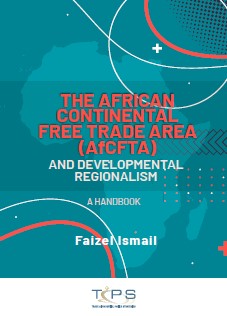 The African Continental Free Trade Area (AfCFTA) and Developmental Regionalism: A Handbook
By Faizel Ismail
This handbook is intended to provide negotiators, policymakers and other stakeholders with an overview of the theory and implementation of the AfCFTA and regional integration in Africa, and to raise questions that could facilitate discussion and dialogue by all stakeholders at the country, Regional Economic Community and African Union levels. It is also about ideas and values and the importance of critical thinking when considering appropriate policies for the development of the African continent. This is particularly important as African countries accelerate the process of structural transformation and industrialisation of Africa.
It is envisaged that this manual will become a building block and point of reference. In this context a few questions are raised after each chapter to stimulate questions for discussion and learning.
Professor Faizel Ismail is the Director of the Nelson Mandela School of Public Governance at the University of Cape Town. He has a PhD in Politics from the University of Manchester, United Kingdom (2015); an MPhil in Development Studies from the Institute of Development Studies (IDS), Sussex (1992), and BA and LLB Degrees from the University of KwaZulu-Natal (Pietermaritzburg) in South Africa (1981 and 1985). He has served as the Ambassador Permanent Representative of South Africa to the WTO (2010-2014). He was also South Africa's Special Envoy on the South Africa-USA AGOA negotiations between January 2015 and June 2016. He is the author of three books on the WTO: Mainstreaming Development in the WTO: Developing Countries in the Doha Round (2007) and Reforming the World Trade Organization: Developing Countries in the Doha Round (2009). His latest book was published by the South Centre and TIPS: WTO Reform and the crisis of multilateralism: A Developing Country Perspective (2020).
Download a copy for read online The African Continental Free Trade Area (AfCFTA) and Developmental Regionalism: A Handbook
Published by Trade & Industrial Policy Strategies
Media
South Africa's just transition must accomodate myriad of considerations (Tasneem Bulbia, Engineering News, 3 June 2021)
Going coal turkey: SA's dilemma as it aims to develop greener economy (Lameez Omarjee, Fin24, 7 June 2021)
Press release
Tangible plans for economic diversification critical to a just transition in Mpumalanga
Media
Going coal turkey: SA's dilemma as it aims to develop greener economy (Lameez Omarjee, Fin24, 7 June 2021
South Africa’s just transition must accommodate myriad of considerations (Tasneem Bulbulai, Engineering News, 3 June 2021)
BackgroundSouth Africa has initiated a transition to a more sustainable development pathway, which involves moving towards a low-carbon economy. The country is a highly unequal society with many poor and vulnerable people. The need for a just transition has emerged as an imperative, whereby the poor and vulnerable should not be negatively impacted by the transition and should ideally be better off through it. In Mpumalanga, these challenges are exacerbated by the health, air and water pollution that has caused untold death and destruction to people and the environment.
Yet the voice of the people living in affected communities is often not heard, particularly at the national level. This Development Dialogue webinar aims to provide a platform to hear from, and engage with, people from Steve Tshwete and Emalahleni. It aims to unpack the key concerns, aspirations, visions and needs for people in Mpumalanga, focusing on what is required to shift the status quo and make a positive change in the region in terms of employment, poverty, energy, health, and the environment. It forms part of a larger project, funded by UK PACT, that intends to facilitate the co-development of a coherent just transition plan for affected communities in Mpumalanga, with a particular focus on Emalahleni and Steve Tshwete.
Programme
Welcome and introduction, facilitated by Peta Wolpe
Brief overview of the UK PACT project
About the Speakers
Jay Naidoo is a South African public figure and social activist. He is a board member of the Mo Ibrahim Foundation, promoting governance and leadership in Africa. Previously, he was a Minister in President Nelson Mandela's Cabinet and the Founding General Secretary of Congress of South African Trade Unions (COSATU).
Promise Mabilo is the co-ordinator of Vukani Environmental Justice Movement in Action (VEJMA), a community-based organisation in eMalahleni, Mpumalanga. The organisation was established in 2016 with the vision of promoting awareness of and advocating for environmental justice within the Mpumalanga Highveld and the country. Mabilo is an environmental justice activist and an alumni of the groundWork environmental justice school.
Lucky Moni is an Energy Researcher and National Educator at the Chemical, Energy, Paper, Printing, Wood and Allied Workers' Union (CEPPWAWU), based in Mpumalanga.
Nonkululeko Makua is the Climate Change Champion of the Emalahleni Municipality. She is also the Manager for Parks, Cemeteries and Public Open Spaces, in the Environmental and Waste Management Directorate of the municipalities.
Alex Khumalo is the Head: Social Performance at Minerals Council South Africa. He has long-standing experience and expertise in socio-economic development, transformation strategies, community engagement and community empowerment, notably as the Owner and Chief Impact Officer of Lean Logic Solutions, and the Community Engagement Officer at Anglo American Platinum.
About the Facilitator
Peta Wolpe is an Energy and Climate Change Practitioner. She has extensive experience of working in urban energy and climate change, focusing on energy poverty and local level governance and policy. She was the Managing Director of Sustainable Energy Africa (SEA) for over 12 years. She is also an Associate Director of SouthSouthNorth.

FDI Tracker Q3 and Q4 2020
This FDI Tracker presents an analysis of foreign investment projects captured in Q3 and Q4 of 2020. It covers two quarters due to low investment activity in Q3 2020 combined with general delays in the release of company and aggregated data, such as those which inform the investment environment analysis. The slowdown in economic activity in response to the COVID-19 pandemic impacted global investment throughout 2020; however, as strict lockdown regulations were eased in the latter half of the year and the South African economy began to gradually resume operations, investment activity appeared to increase again. A crucial driver of the rise in investment projects in Q4 2020 was the South African Investment Conference held in November 2020 where a number of foreign investment pledges were made. In the report, investments from the conference and those announced separate from the conference are distinguished when relevant. A total of 37 projects were recorded over the two quarters with nine projects identified in Q3 2020 and 28 projects in Q4 2020.
Download the FDI Tracker or read online
Media
Press release: South Africa’s manufacturing sector gets a boost of foreign direct investment
South Africa's manufacturing sector gets FDI boost, TIPS Trcker finds - By Tasneem Bulbulia, Engineering News, 26 May