


Janet Wilhelm
Export Tracker - Q4 2020
South Africa’s robust third quarter recovery in merchandise exports continued in the fourth quarter of 2020, growing at an even faster pace by 16.6% (quarter-on-quarter), amounting to R412 billion. The decline in imports moderated to -6.3%, amounting to R307 billion, in constant rand terms compared to the -19.6% decline in Q3 2020 (quarter-on-quarter). The fourth quarter of 2020 recorded a trade balance of R104 billion (US$6.7 billion), marking South Africa’s seventh straight quarter trade surplus.
In US dollar terms, merchandise exports were up by 13.4% (quarter-on-quarter) to US$26.4 billion, while imports declined by 8.9% in Q4 2020 to US$19.7 billion. Taking into account the COVID-19 containment measures and possible effectiveness of the mass vaccination programmes being implemented in most countries globally, and the ongoing surge in metals prices, South Africa’s export performance is expected to continue on a steady growth path.
Download a copy of the Export Tracker or read online
The Import Localisation and Supply Chain Disruption study is a quarterly report that seeks to identify goods from the list of imports identified in the Import Tracker report that South Africa could possibly viably manufacture. Each quarter focuses on five manufactured items from the list of imports in the corresponding quarter's Import Tracker report. The five products in this report are:
Product 1: Semi-milled or wholly milled rice, whether or not polished or glazed
Product 2: Parts for boring or sinking machinery
Product 3: Medical instruments and appliances
Product 4: Parts and accessories of printers, copying machines and facsimile machines
Product 5: Oilcake and other solid residues from the extraction of soyabean oil
Terms of Reference: Development of the Forest Products Research Strategy for South Africa
The purpose of these Terms of Reference is to develop a forest product roadmap with a specific focus on:
- Addressing the use of timber and engineered timber products in the built environment;
- Identifying and promoting the development of short- and long-term efficient bio-refineries technology innovation opportunities to drive forestry sector competitiveness and productivity improvement in the emerging market sectors of bio-based chemicals, materials and bio-energy
- Identification, development and commercialization of products
- Human capacity building on efficient forest products development and utilization technologies.
You can download a copy of the full ToR document or read it online.
Closing Date: 11 June 2021 at 16h00
Proposals should be sent to Trade & Industrial Policy Research Strategies (TIPS) for the attention of Ms. Daphney Mabuza (daphney@tips.org.za)
The African Continental Free Trade Area (AfCFTA) and Developmental Regionalism: A Handbook
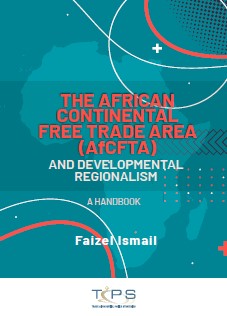 This handbook by Faizel Ismail is intended to provide negotiators, policymakers and other stakeholders with an overview of the theory and implementation of the AfCFTA and regional integration in Africa, and to raise questions that could facilitate discussion and dialogue by stakeholders at the country, Regional Economic Community and African Union levels. Download a copy.
Thandika Mkandawire Prize for Outstanding Scholarship in African Political Economy and Economic Development
The African Programme on Rethinking Development Economics (Aporde) and the South African Research Chair in Industrial Development (SARChI Industrial Development) are delighted to announce the inaugural Thandika Mkandawire Prize for Outstanding Scholarship in African Political Economy and Economic Development. This prize is to be awarded annually to recognise outstanding research papers by African scholars. A second award, the Thandika Mkandawire Prize for Young Scholars in African Political Economy and Economic Development, is specifically for young researchers.
The call is now open for submissions for the 2021 award. Submissions close on 30 June 2021.
The awards:
Thandika Mkandawire Prize for Outstanding Scholarship in African Political Economy and Economic Development
- The author/s of the winning submission will receive an award of $6 000 and a certificate. There are no conditions attached to the utilisation of the prize.
- The winner/s will be invited to present the winning paper at Aporde, and to attend any lectures of interest.
Thandika Mkandawire Prize for Young Scholars in African Political Economy and Economic Development
- The author/s of the winning submission will receive an award of $2 000 and a certificate. There are no conditions attached to the utilisation of the prize.
- The winner/s will automatically be invited to attend Aporde 2021 (should they not already be Aporde alumni).
- Should the winner/s wish, they will receive mentorship from a leading scholar linked to Aporde, on preparing the research for publication.
The winners will be announced in early August. The decisions of the selection committees are final and no correspondence will be entered into. The selection committees reserve the right not to make awards.
Submissions will be judged on the following criteria:
- Quality of the research (in particular: originality and contribution to knowledge, rigour, and clarity and coherence).
- Alignment with the theme of African political economy and economic development, and with the intellectual legacy of Thandika Mkandawire.
Eligibility:
- Authors must be citizens of an African country.
- For the Young Scholars award, applicants must be under 35 years of age as of 30 June 2021.
- Submissions may be co-authored, with no more than two authors in total. In the case of co-authored submissions, both authors must meet the citizenship eligibility criterion, and the age criterion in the case of the Young Scholars
- The research may be published or unpublished. If already published, it should not have been published before 2020.
- All submissions should be between 8-9 000 words in total, inclusive of all references, footnotes/endnotes, abstract, tables and figures, and appendices.
- Papers may be from any relevant disciplinary background and may use any methodological approach.
Submissions must include the following:
- Original research paper, in word format, without any identifying information (such as names of authors or acknowledgments), with word length strictly as per the above.
- A signed cover page stating: the title of the paper; names and contact details of author/s; abstract; acknowledgments; total word length; an indication of which award the submission is for; a declaration that the paper is an original piece of research; and details of publication (where papers have already been published). The cover page should be signed by both authors in the case of co-authored submissions.
- CVs of all authors.
- Copy of passport or national identity document for each author
Submissions should be sent to koketsom@uj.ac.za by the closing date of 30 June 2021. No late, incomplete or non-compliant applications will be considered.
About Professor Thandika Mkandawire

Thandika Mkandawire (1940-2020) was a Malawian political economist who made fundamental contributions to thinking around African economic development. He held various positions, including as Director of the United Nations Research Institute for Social Development (UNRISD) and Executive Secretary of the Council for the Development of Social Science Research in Africa (CODESRIA). At the time of his passing, he held a Chair at the London School of Economics, having previously been a professor at universities in Zimbabwe and Sweden. He passed away in Sweden, where he had lived for many years.
As the reality of a coal transition and coal power decommissioning draw nearer, South Africa’s just transition plan is both urgent and glaringly absent. There is a pressing need to manage the impacts of the transition on workers and local economic development, particularly in coal-dependent regions and affected communities. A credible fact base is required, from which to make appropriate and broadly supported decisions. In this conceptual clearing, several specific political consensuses must be brokered to enable policy design and implementation as well as investment for a green and just transition. This policy brief speaks to the current policy vacuum, proposing steps to address it. First, it considers the implications of the coal transition for employment in South Africa, with reference to national policy and available research. It then seeks to characterise the key issues, points of contestation, and the current just transition/ employment policy vacuum. Finally, recommendations for the facilitation of shared understanding and consensus-building are outlined.
Dowload Policy Brief or read online
Webinar: The economic impact of COVID-19 on SADC
Presentations
Neva Makgetla - Senior Economist, TIPS
Presentation: The pandemic and the economy in southern Africa
Klaus Schade - Independent Economic Analyst in Namibia
Presentation: The economic impact of Covid-19 on SADC: The Namibian experience
Gibson Chigumira - Executive Director, Zimbabwe Economic Policy Analysis and Research Unit (ZEPARU)
Presentation: Synopsis of COVID-19 situation and policy responses in Zimbabwe
Itumeleng Mokoena - Intern, TIPS
Presentation: The COVID-19 pandemic and the economy in Southern Africa: Botswana's response
Additional Research
The COVID-19 pandemic and the economy in Southern Africa
Media
Tourism bears brung of Covid-19 pandemic across SADC - researchers (Lameez Omarjee, Fin 24, 21 May 2021)
Southern African countries' Covid-19 economic recovery rapid – TIPS (Donna Slater, Engineering News, 19 May 2021)
Press release
COVID-19 leaves SADC poor worse off
This Development Dialogue takes place in the context of the SA-TIED programme. It provides an overview of the economic impact on SADC, and then unpack the specific issues impacting on Namibia, Zimbabwe and Botswana.
|
14:00 Opening and welcome by chairperson: Themba Khumalo 14:05 – 15:05 Presentations: · Neva Makgetla: Overview of the economic impact on SADC · Klaus Schade: Namibian experience · Gibson Chigumira: Zimbabwean experience · Itumeleng Mokoena: Botswanan experience 15:05 – 15:30 Discussion |
|
Background As in the rest of the world, the COVID-19 pandemic had a severe economic fall-out in Southern Africa, which endured an economic depression in 2020. The economic outcomes varied significantly over the course of the year, however. A sharp downturn linked to regional and international lockdowns in the second quarter was followed by a rebound in the remainder of the year. For 2020 as a whole, the regional GDP was around 6% below 2019. The available evidence indicates that the pandemic depression aggravated inequalities in Southern Africa, which were already among the worst in the world. Less-skilled workers saw a disproportionate loss of livelihoods; small businesses were also more likely to close down than larger ones; and government cuts to services in response to falling revenues had the sharpest impact on low-income households and communities. |
|
About the Speakers Themba Khumalo is the Director of Africa Integration and Industrial Development at South Africa’s Department of Trade, Industry and Competition. Neva Makgetla is a senior economist at TIPS. Makgetla has published widely on the South African economy and worked for many years in government. Klaus Schade is an independent economic analyst in Namibia. Gibson Chigumira is the Executive Director of the Zimbabwe Economic Policy Analysis & Research Unit (ZEPARU). Itumeleng Mokoena is an intern at TIPS. |
The Import Localisation and Supply Chain Disruption study is a quarterly report that seeks to identify goods from the list of imports identified in the Import Tracker report that South Africa could possibly viably manufacture. Each quarter focuses on five manufactured items from the list of imports in the corresponding quarter's Import Tracker report. The five products in this report are:
Product 1: Automotive components for goods vehicles
Product 2: Generating sets, wind-powered
Product 3: Alcoholic and other solutions used in the food and drink industries
Product 4: Static converters
Product 5: Parts for telephones, routers and other telecoms devices
The Import Localisation and Supply Chain Disruption study is a quarterly report that seeks to identify goods from the list of imports identified in the Import Tracker report that South Africa could possibly viably manufacture. Each quarter focuses on five manufactured items from the list of imports in the corresponding quarter's Import Tracker report. The five products in this report are:
Product 1: Urea, whether or not in aqueous solution
Product 2: Dextrins and other modified starches
Product 3: Cards incorporating one or more electronic integrated circuit "smart cards": digital
Product 4: Machines for the reception, conversion and transmission or regeneration of voice, images or other data, including switching and routing apparatus: other
Product 5: Photosensitive semiconductor devices, including photovoltaic cells
The Import Localisation and Supply Chain Disruption study is a quarterly report that seeks to identify goods from the list of imports identified in the Import Tracker report that South Africa could possibly viably manufacture. Each quarter focuses on five manufactured items from the list of imports in the corresponding quarter's Import Tracker report. The five products in this report are:
Product 1: Telephones for cellular networks "mobile telephones" or for other wireless networks: designed for use when carried in the hand or on the person
Product 2: T-shirts, singlets and other vests of cotton, knitted or crocheted
Product 3: Footwear with outer soles of rubber, plastics or composition leather, with uppers of leather (excluding covering the ankle, incorporating a protective metal toecap, sports footwear, orthopaedic footwear and toy footwear): other
Product 4: Dumpers for off-highway use: 0ther
Product 5: Wire of refined copper with a maximum cross-sectional dimension of >6 mm