

Janet Wilhelm
Economic Risks from Climate Change Fall Under the Spotlight
Engineering News
Climate change is increasingly recognised as one of the defining issues of the 21st century, drawing all elements of society towards the promotion of a prosperous, low carbon future. Even in times of economic recession, climate change has not fallen off the radar, with many major economies rather viewing 'green' led investment as an engine for economic recovery.
South Africa has become increasingly involved in addressing climate change issues, from our involvement in international climate negotiations, the modelling of potential mitigation scenarios under the Long Term Mitigation Scenarios (LTMS) process, and the current development of a national Climate Change White Paper. A significant amount of work has also been done to consider the direct impacts of climate change on the South African environment, including physical impacts related to higher temperatures, sea level rise, increased risk of wild fire and concerns over future water availability.
Despite these efforts, less emphasis has been placed on the indirect impacts of climate change, including how industry could be affected by shifts in consumer preferences, how the evolving carbon regulation environment in South Africa might affect industry, and how business and the economy as a whole should respond to these challenges.
To address this gap, research is currently underway that considers the indirect effects that climate change could have on South Africa's economy, ranging from impacts on the tourism sector, aviation and food exports, through to commercial opportunities in low carbon technologies and the promotion of alternative carbon markets. The project is being led by Camco, an international consulting firm specialising in climate change solutions, in partnership with Trade and Industrial Policy and Strategies (TIPS) and the ComMark Trust, with support provided by the British High Commission.
As part of the project, a stakeholder workshop including representatives from the private sector, national and local government, non-governmental organisations and the donor community is to take place in Sandton in mid-August, in order to discuss and debate the economic risks and opportunities posed by climate change for South Africa. Key questions to be discussed at the multi-stakeholder workshop include:
- What commercial risks and opportunities do companies face from climate change?
- How can we address these issues?
- How will 'air miles' and the demand for low carbon goods impact South African manufacturing and exports?
- Is the tourism sector adequately prepared for pressures to promote 'local tourism' within industrialised nations?
- What opportunities are presented for trade in environmental services by climate change, including through land use improvements and carbon sequestration?
- How can industry respond to a carbon tax regime in South Africa, and are there alternatives?
- How can we fast-track activities that combat climate change and promote poverty alleviation and socio-economic development?
The research underway is premised on the understanding that climate change is not just an environmental issue, but could have significant implications for trade, investment and industry competitiveness. South Africa is a carbon intensive economy, and is therefore exposed to a number of potential climate change related liabilities. Nevertheless, risk is often the precursor of opportunity, and considerable scope exists for the South African economy to shift these potential liabilities into market enablers, as the LTMS and other studies have begun to explore.
The research will help to take the climate debate in South Africa forward, identifying economic opportunities presented by climate change and exploring synergies with national priorities relating to job creation, enterprise development and poverty alleviation. The notion of 'green jobs' has come increasingly to the fore in recent years, and highlights that a number of national efforts to address climate change could promote economic growth as well as support environmental protection.
Across the globe, companies are exploring opportunities in low carbon development in a bid to differentiate themselves and maintain market share. Effectively positioned, the South African economy could weather any severe 'climatic' storms, whilst maximising on commercial opportunities and new markets.
For media enquiries please contact:
Alex McNamara Camco South Africa
Tel: (0)11 253 3400 Cell: (0)79 699 3284 Email: alex.mcnamara@camcoglobal.com
To view the article published on the Engineering News click here
Introduction to Economy-Wide Impact Analysis and Modelling
Most economics curricula deal with macroeconomic tools for studying the economy as a whole and microeconomic tools for studying the behaviour of individual agents or markets. However, practical public and private sector economic analysts often need an economy-wide focus that combines the macroeconomics of the economy as a whole with structural detail that permits analysis of impacts at the sector or household level and of the consequences of interactions amongst them. Applications for participation should be sent to denves@xtra.co.nz and should be accompaniedby a completed application form (click on link below).
SADRN Researchers Workshop
- To increase the supply of policy-relevant research in SADC by creating a pool of suitably-skilled researchers based in institutions in SADC;
- To improve the policy-relevance of research through growing the capacity of policy-makers to be discerning research users;
- To develop an appreciation of evidence-based policy making by engaging policy-makers in the design, specification, implementation and review of research projects; and
- To build institutional capacity in key organizations in SADC by creating centres of excellence in focused thematic areas of research.
SADRN Industrial Policy Inception Workshop
SADRN contributed to some of regional integration efforts through a particular initiative by coordinating industrial policy workshop in South Africa on September�� 9 - 10, 2008. The initiative was closely linked to some of SADC's regional goals encompassed in the Regional Indicative Strategic Development Programme and the broader vision of a "common future"�� as well as�� the on-going development of regional industrial policy framework by the SADC Secretariat. The workshop provided the first steps to facilitate research, discussions and debates between the research community, policy makers and other relevant stakeholders in the area of industrial policy in the SADC region. The workshop engaged a number of policy makers and researchers across a range of SADC countries and was facilitated by Prof. Carlo Pietrobelli.
For more information on the workshop, a full report is available for download below.
The "Services Sector Development" Thematic Working Group was launched on the 18th of June 2009 at La Pirogue hotel in Mauritius. The launch was coupled with a workshop on the same theme, whereby participants from several ESA countries discussed on potential and prospective research on the theme. SADRN has earmarked 11 studies around the theme to be funded under the "Services Sector Development" theme. The Coordinator for this theme is Mr Sawkut Rojid who is a lecturer at the University.
Participants were mainly researchers from Namibia, Botswana, Uganda and Mauritius. The SADRN Network Coordinator was also in attendance as well as the entire coordinating team for the "Service Sector Development" TWG.�� �� There resource person for the launch workshop was Dr Tabitha Kiriti from the School of Economics at University of Nairobi, Kenya. She specialises in International Economics, Development Economics and Macroeconomics. She has also published in more than 30 journal articles in these fields, including trade in service research.
Four research proposals were presented and discussed at the workshop. Although five proposals have been considered, one researcher could not attend the launch workshop due to other commitments. The titles of those proposals are given below as follows:
- 1. Prospects for the establishment of an education hub: The case of Botswana
- 2. Railway Sub-Sector Contribution to Poverty Alleviation in Namibia
- 3. Services Sector Development in Uganda: An Analysis of the Role of the Financial Services Sector
- 4. Services Sector Development: A Key to Poverty Alleviation and Sustainable Development in Mauritius
The official launch was taken seriously and respected by the University and Faculty Management. The Dean of the Faculty of Law and Management, Associate Professor Jawaheer was present at the launch and he had the opening remarks.�� The two Vice Chancellors of the UoM, Prof. Ghurib-Fakim and Prof. Rughooputh were also in attendance. Prof. Ghurib-Fakim was given an opportunity to speak on behalf of UoM. He praised the Launch of SADRN TWG on "Services sector Development" as a sign of confidence in the UoM and�� thought that the contribution of such an initiative to the University, young researchers as well as regional integration in Eastern and Southern Africa will be immeasurable. Both speakers were full of praises for the initiative, but especially for International Development Research Centre (IDRC) for providing the funding and opportunities for young researchers to get exposure on these issues.
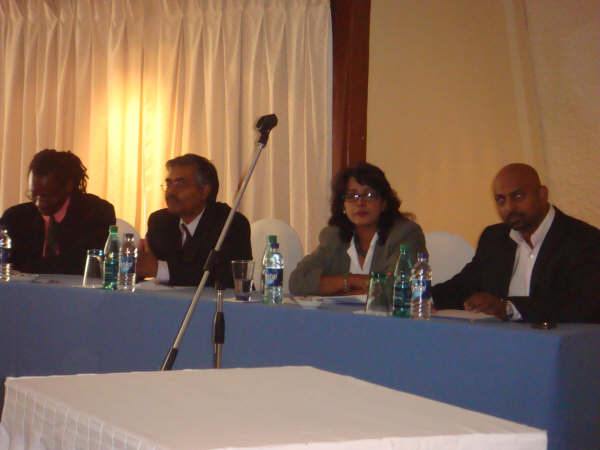
Names, from left to right:
Mr Mmatlou Kalaba, TIPS Trade Economist and SADRN Network Coordinator; Prof Rughooputh Sunil, Acting Vice Chancellor of the University of Mauritius; Prof Ameenah Ghurib-Fakim, Pro Vice Chancellor, Teaching and Learning and Mr Sawkut Rojid, lecturer at the University and Services Sector Development Theme Coordinator.
Johan Fourie
Tourism from a Trade Perspective: Sources of Comparative Advantages and Implications for South Africa and the Region
About Johan Fourie
Johan Fourie is lecturer in the Department of Economics at Stellenbosch University. Johan is currently pursuing his PhD in Economic History at Utrecht University. His interests are wide ranging and include not only trade in services but also South Africa's economic history, infrastructure and the Economics of Sport. Johan's latest publications include "An application of attractiveness measures to evaluate the structure of the Currie Cup" in South African Journal for Research in Sport, Physical Education and Recreation, forthcoming and "A note on infrastructure quality in South Africa" in Development Southern Africa, Vol. 25, No. 4, October 2008. In 2008 he participated to the TIPS Annual Forum and presented on "The Development and Importance of Travel Service Exports from South Africa".
About Wamkele Mene
Wamkele Mene holds the position of Director: Trade in Services at the International Trade & Economic Development Division of the dti. He focuses on multilateral, bilateral and regional trade in services negotiations. As South Africa's Lead Negotiator on services trade, Wamkele provides strategic and policy leadership in all trade in services negotiations that South Africa is involved in. An integral part of Wamkele's work is the crafting and negotiation of favourable market access conditions for South African exporters of services. He is a graduate of Rhodes University, the University of Detroit Mercy and the Centre for International Studies & Diplomacy at the University of London.
About Professor Melville Saayman
Professor Saayman is at the School of Business Management in the Faculty of Economic and Management Sciences at North-West University, Potchefstroom Campus. He is an expert in Tourism Economics and in Tourism management and development. Professor Saayman is Director of the Institute of Tourism and Leisure Studies
(see http://www.tourisminstitute.co.za/index.php?option=com_content&view=article&id=2&Itemid=2).
Dr. Neil Rankin
What Do We Know About South African Exporters From Micro-Data?
About Dr. Rankin:
Dr Neil Rankin is a Senior Lecturer and the founding Director of the African Microeconomics Research Umbrella (AMERU) in the School of Economic and Business Sciences, University of the Witwatersrand (Wits).
Dr Rankin obtained his doctorate from the Centre for the Study of African Economies, University of Oxford in 2005 and has, since then, been based at Wits. His research interests are in the field of applied microeconomics. These include: the links between firm performance and labour market outcomes; the impact of trade on firms and workers; the microeconomic aspects of inflation and pricing; and the determinants of educational outcomes. Much of this research is based on primary data that he has been involved in collecting, both in South Africa and a number of other African countries.
Dr Rankin's recent publications include: "South African Exporting Firms: What Do We Know and What Should We Know", Journal of Development Perspectives, 4 (1): 93-118 with Edwards, L. and Schoer, V. (2008) and "Price setting in South Africa 2001 to 2007 - stylised facts using consumer price micro data", Journal of Development Perspectives, 4 (1): 93-118 with Creamer, K. (2008).