

Janet Wilhelm
What Can Developing Countries Learn About Curbing Inequality From The Record Of Industrial Countries?
TIPS has the pleasure to invite you to the following Development Dialogue Seminar:
Professor Albert Berry on
What Can Developing Countries Learn About Curbing Inequality From The Record Of Industrial Countries?
About Professor Albert Berry:
Albert Berry is Professor Emeritus of Economics and Research Director of the Programme on Latin America and the Caribbean at the Centre for International Studies at the University of Toronto.
Professor Berry obtained his PhD from Princeton in 1963. His main research areas, with focus on Latin America, are labour markets and income distribution, the economics of small and medium enterprise, and agrarian structure and policy. However, his main ongoing research project is on the role of small and medium enterprises under the current open-economy setting of Latin American and other developing countries, and a related analysis of the labour market impacts of increasing openness.
Professor Berry has worked with the Ford Foundation, the Colombian Planning Commission, and the World Bank, and acted as consultant for a number of international and other agencies. He has, in the recent past, worked on South Africa's industrial structure, with a particular focus on SMMEs.
Professor Berry has published more than 100 papers in learned journals and is the editor or co-editor of a number of books including Critical Issues in International Financial Reform (Transaction Publishers, 2003), Labor Market Policies in Canada and Latin America (Kluwer Academic Publishers, 2001), and Poverty, Economic Reform, and Income Distribution in Latin America (Lynne Rienner, 1998).
India Emerging - Reality Checks in a Globalizing Economy
TIPS has the pleasure to invite you to the following Development Dialogue Seminar:
Dr.Veena Jha
India Emerging: Reality Checks in a Globalizing Economy
About Dr. Jha
Dr. Veena Jha is a Visiting Professorial Fellow at the Institute of Advanced studies, University of Warwick, UK, and a research fellow at the International Development Research Centre, Canada. She is also the executive director of Maguru Consultants Limited, London, UK.
Dr Jha holds a PH.D from the London University, U.K. She has worked extensively on trade and environment issues for over twenty years. She has worked with the United Nations in various capacities for over twenty years. She was the Coordinator of an important UNCTAD/DFID/Government of India initiative on 'Strategies and Preparedness for trade and Globalisation in India'.
Dr Jha has published twelve books on trade and development issues, articles in journals, and was a member of some consensus building initiatives on trade and environment issues in the last decade. She has been a member of several national and international Advisory Boards, notably the United Nations Secretary General's Task Force on Millennium Development goals. She has served as an expert on technical committees of the Government of India, industry associations, and non-governmental organisations on trade and development issues. She has advised several developing country governments on trade and development issues.
South Africa and the Credit Crunch
Nicola Viegi (UCT)
Ben Smit (BER & Stellenbosch)
& Christopher Loewald (National Treasury)
South Africa and the Credit Crunch.
About the panel members:
Dr Christopher Loewald was appointed Deputy Director-General of the new Economic Policy Division of the National Treasury in March 2006. He ran the 2006 Budget as Acting Deputy Director General for the Budget Office and the Chief Director for Fiscal Policy. From 1998 to 2005 he was responsible for macroeconomic policy and international economic policy, including the development of the inflation targeting framework. He co-chairs the Macroeconomic Standing Committee of the Reserve Bank and Treasury, and is a member of the South African Statistics Council. He completed his M.A. and Ph.D. at Johns Hopkins University.
Prof Ben Smit is currently Director of the BER and Professor of Economics at the University of Stellenbosch. He was appointed Director of the BER in 1998 but continues to lecture post-graduate students in the Department of Economics, which he joined in 1975. In 1985/86 Prof Smit spent a year at the University of Pennsylvania and the Wharton School of Econometrics in the USA.
Professor Smit has been involved with numerous consulting positions including at the Department of Finance (1992 - to date), the Development Bank of Southern Africa (1994 - 1995) and the World Bank (1996 - 1998). He was involved with the macro-Economic Strategy for Growth, Employment and Redistribution (GEAR) in 1996.
Prof Smith is a Member of numerous editorial boards - including those of Studies in Economics and Econometrics and of Management Dynamics: Contemporary Research Journal of the Southern Africa Institute for Management Scientists.
Prof Nicola Viegi is an Associate Professor in economics at the University of Cape Town. A graduate from the Scottish Doctoral Programme in Economics, he has been a lecturer in economics at the University of Strathclyde in Glasgow, invited lecturer at the University of Malta and at the Ecole Superior de Commerce in Toulouse. He has been a regular Visiting Scholar at De Nederlandsche Bank. Nicola's main areas of research are economic policy theory, macroeconomic modelling and regional macroeconomic integration. Current research includes inflation targeting under uncertainty, monetary policy and asset prices, and macroeconomic integration in Southern Africa.
Employment Intermediation for Unskilled and Low-skilled Work Seekers - Part 1: Overview of the Sector
Unemployment is one of the biggest challenges facing South Africa. Growth has been inadequate, the skills level requirement of new jobs is continually rising, current skills among the workforce are low and inadequate numbers of low end, unskilled jobs are being created. Finding mechanisms to address this challenge is a key to South Africa’s economic success and the social cohesion of communities. This task demands a combination of macro and microeconomic strategies and falls outside the ambit of this project.
However, with over 500,000 unemployed people applying for placement in a job or for assistance with unemployment insurance through the Department of Labour, and tens of thousands more who are not eligible turning to private and non-governmental organisation (NGO) operators to assist them find work, there is an important role for employment intermediation services in South Africa. Most of those approaching the Department of Labour and the private and NGO operators reviewed in this report are unskilled or semi-skilled workers servicing the lower skills end of the labour market.
There is, in most countries, a mismatch between the demand for workers and the supply of job seekers. The causes of this vary from country to country and include: limited information and dissemination on job openings, mismatches between the skills of workers and the demand of employers, the increased mobility of labour, changes in the nature of work, a demand for more frequent upgrading of skills, poor job hunting skills by workers, labour market discrimination, and barriers to access, such as geographic location and the high costs of transport. This can contribute and exacerbate unemployment, as well as long term unemployment of certain groups of people, and/or underemployment.
The Botswana Institute for Development Policy Analysis (BIDPA) hosts the thematic research area "Trade Policy and Pro-Poor Growth", under the Southern African Development Research Network (SADRN). SADRN is hosted by the Trade and Industrial Policy Strategies (TIPS) in South Africa and is funded by the International Development Research Centre (IDRC).
The mandate of the network is to ensure that the Southern African Development Community (SADC) countries have the requisite research and negotiating capacity to enable them to negotiate for a fair share of the benefits of global trade at the WTO and other fora. Specifically, the network has the objective to achieve trade, growth, globalization and poverty reduction through:
- Increasing supply of policy-relevant research in SADC by increasing the pool of suitably-skilled researchers based in institutions in SADC;
- Improving the policy relevance of research by developing the capacity of policy makers to discerning research users;
- Developing an appreciation of evidence-based policy making by engaging policy makers in the design, specification, implementation and review of research projects; and
- Building institutional capacity in key organizations in SADC by creating centers of excellence in focus thematic areas of research.
To meet the SADRN objectives of increasing supply of policy relevant research in SADC, BIDPA, under the auspices of the "Trade Policy and Pro-Poor Growth" theme invites government departments (or government research departments) from SADC Member States to submit proposals to be considered for research on Trade Policy and Pro-Poor Growth.
Submission Instructions
Submit a proposal describing your topic of interest; proposed methodology; motivation for the topic and its potential impact in your respective country (or in the SADC region) and the proposed budget.
Please note that the identified research topic should be in line with the theme and should be of policy relevance to the country concerned.
Guidelines for submission:
Deadline for submission: 24th April, 2009
Notification of the accepted paper: 4th May, 2009
- Notification of receipts will be sent to the designated authors soon after receipt of the proposal.
Funding
Funding is available for only one project and as such only one proposal will be selected from the submitted proposals.
For further information regarding the project please contact, Professor Roman Grynberg
BIDPA Thematic Working Group Project Coordinator at rgrynberg@bidpa.bw or ? 3971750 or fax to ? 3971748.
For more general information on SADRN, please see: http://www.tips.org.za/programme/sadrn
Daphney Mabuza
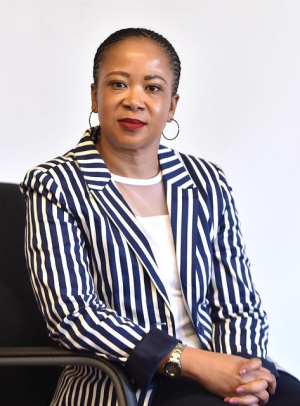
Daphney Mabuza joined TIPS in November 2013. She has 13 years' working experience in administration, including project administration and logistics management. Before joining TIPS she was at JSI Inc under the umbrella of National Department of Health (HIV/AIDS and STI Cluster) and at SAHCD for the retention study of the health workers within the SADC Region. She was at Cheadle Thompson & Hayom as the project administrator providing support for Land Tenure. She was also with the University of Pretoria Trust as an administrator at the Business Development Unit, responsible for the management and development of new business and the administration of the Intellectual Property projects.
Moving Away from Resource Dependence
Dr. Neva Makgetla
Moving Away from Resource Dependence.
About Dr. Neva Makgetla:
Dr Neva Makgetla is lead economist for research and information at the Development Bank of Southern Africa (DBSA), which she joined in October 2008. She is seconded part-time as Sector Strategies Co-ordinator for the Presidency.
From 2006 to 2008, Dr Makgetla worked at the Presidency full time on sector strategies. From 2000 to 2006, she was policy co-ordinator for fiscal and monetary policy and, from 2005, head of the policy unit at the Congress of South African Trade Unions (COSATU). She represented labour as a member of the Securities Regulatory Panel, the Financial Sector Charter Council and the Employment Equity Commission.
Since 2003, Dr. Makgetla has had a fortnightly column in Business Day.
From mid-1995 to 2000, Dr. Makgetla worked for the South African government, including, between 1997 and 2000, as Deputy Director General for Remuneration and Conditions of Service and chief negotiator for the State as employer.
Before entering the public service, Dr. Makgetla worked for the National Labour and Economic Development Institute (NALEDI), which is associated with the COSATU. She lectured in Economics at universities in Africa and the U.S. from 1982 to 1994, including as senior lecturer at the University of the Witwatersrand in Johannesburg from early 1991 to late 1994. In this period, she was a member of the Department of Economic Planning of the African National Congress of South Africa, and in 1993/4 was economics co-ordinator of the Reconstruction and Development Programme.
Dr. Makgetla completed her B.A. (Hons) at Harvard University and her Ph.D. in Economics in Berlin.
RSVP by email: Ipeleng@tips.org.za to confirm attendance.
Cheese and wine will be served after the talk.
The presentation slides for the Seminar are available below:
Regional Forum on "Enhancing Competitiveness in Southern Africa: A Roadmap for Success"
The Regional Forum on Enhancing Competitiveness in Southern Africa: Roadmap to Success was organised by Southern Africa Global Competitiveness Hub from 9th to 10th of February 2009 in Johannesburg South Africa. It was attended by government officials and members of the business community in the region. There were guests from World Trade Organisation, World Customs Organisation, USA governments and business communities as well as from the SADC Secretariat.
The topics covered at the forum included Challenges to Competitiveness in Southern Africa, Port Concessions in the Southern African region, Railway Concessions, Removing Barriers at Border Posts, Opening the Skies in Southern Africa, Supporting the Electricity Supply Industry, Setting the Right Price for Energy in the Region, Making SADC Free Trade Area Work for you, Making Customs in SADC More Efficient, Deepening Regional Integration, Attracting Investment in The Region, Trade Facilitation Issues and Global Financial and Economic Distress.
Southern African Development Research Network (SADRN) participated through the Coordinator in the session on "Making SADC Free Trade Area Work for you". The SADRN contribution in that session is available on this website. The rest of the forum presentations will be posted on the website of the Southern Africa Global Competitiveness Hub. The web address is http://www.satradehub.org/.
A Summary Report of the event is available below.
Public Discussion Forum on the Impact of Rising Food and Fuel Prices on Small Business
INVITATION TO A PUBLIC DISCUSSION FORUM: THE IMPACT OF RISING FOOD AND FUEL PRICES ON SMALL BUSINESS
Tuesday 3 March 2009, 09:45 to 13:10
The President of the Foundation for African Business and Consumer Services (FABCOS) , Mr Mxolisi Zwane, invites you and representatives of your company/institution to a public discussion forum on 3 March 2009 in partnership with government, private sector stakeholders and organised business, to discuss the main findings of a commissioned report on The Impact of Rising Food and Fuel Prices on Small Business, and to investigate an appropriate institutional response to these key issues.
To RSVP please fill in the form attached below.
Programme facilitator: Mr Vuyo Mbuli
Registration: 09:15 to 09:45
DRAFT PROGRAMME
|
09:50 - 10:00 |
Welcoming, setting the mandate and handing over to the programme facilitator, Mr Vuyo Mbuli Mr Alan Campbell, COO, FABCOS |
|
10:00 - 10:10 |
Procedure for the session and introduction of the keynote speaker Mr Vuyo Mbuli |
|
10:10 - 10:30 |
Address by key note speaker (speaker to be confirmed) |
|
10:30: - 10:50 |
Introduction of and presentation by Ms Tracy Van Der Heijden, author of the Research Report |
|
10:50 - 11:00 |
Introduction of the Panel of Experts & panel discussion procedures Mr Vuyo Mbuli |
|
11:00 - 12:15 |
Panel discussion, facilitated by Mr Vuyo Mbuli |
|
12:15 - 13:00 |
Q&A session, facilitated by Mr Vuyo Mbuli and the panel |
|
13:00 - 13:10 |
Closing remarks and vote of thanks Mr Mxolisi Zwane, President, FABCOS |
|
13:10 - 14:00 |
Light lunch |
To download the Impact of Rising Food and Fuel Prices on Small Business Report click here.
The Panel Discussion Themes and Preparatory Notes are available below for download.