
- You are here:
-
Home

-
Events
- Development Dialogue Seminars
Trade & Industrial Policy Strategies (TIPS) hybrid Development Dialogue on
Developing the Renewable Energy Industrial Value Chain
Thursday 30 May at 13:00 – 15:00 PM (SAST).
TIPS Dialogues bring together academics, policymakers, civil society organisations, workers, and practitioners
to discuss important issues and share ideas on industrial policy.
PRESENTATIONS
Saul Levin (TIPS) - Greenining Industrial Policy
Gaylor Montmasson-Clair - What would it take to localise the renewable energy value chain in South Africa?
Gerald Nienaber - Case study: Modetech Services
Fazel Ernest - Insights from Labour
MEDIA
Supply-side support will be required if South Africa aims to join green industrialisation race - Engineering News 30 May 2024
POLICY BRIEF
AGENDA
Dr Saul Levin (TIPS) – Presenting on Greening Industrial Policy
Gaylor Montmasson-Clair (TIPS) – What would it take to localise the renewable energy value chain in South Africa?
Gerald Nienaber (Modetech) – Case Study Modetech Services
Fazel Ernest (CEPPWAWU - Cosatu) – Insights from Labour
Background
This Development Dialogue will unpack the opportunities for South Africa in the development of renewable energy and battery storage value chains, in line with the framework of the South African Renewable Energy Masterplan (SAREM) and the country’s broader transition to green industrial policy. The fast-rising roll-out of renewable energy and storage technologies, both domestically and globally, presents an opportunity for South Africa to foster economic development, employment creation and social transformation.
The development of industrial value chains, leveraging South Africa’s existing manufacturing and service provision capabilities, is one such opportunity. Looking ahead, understanding the landscape of opportunities in the value chain and the necessary interventions required to realise the potential will be the focus of the dialogue.
TIPS Dialogues bring together academics, policymakers, civil society organisations, workers, and practitioners to discuss important issues and share ideas on industrial policy.
TIPS is partnering with the Department of Trade Industry and Competition (the dtic).
About the Speakers
Moderator
Muhammed Patel is a Senior Economist at TIPS. He works on TIPS's work on sustainability and just transition. Muhammed’s background spans work in industrial development, and competition and regulatory economics as well as the telecommunications and energy sectors.
Presenters
Saul Levin is Executive Director of TIPS since 2014. He has a PhD in Development Studies from the University of Johannesburg, with his thesis on industrial financing. Saul was previously a chief director in the Economic Development Department (EDD) with oversight of the Development Finance Institutions reporting to EDD. He also held several senior posts in the Department of Water Affairs and Forestry, Department of Minerals and Energy, and Department of Trade and Industry.
Gaylor Montmasson-Clair is a Senior Economist at Trade & Industrial Policy Strategies (TIPS). He leads TIPS's work on sustainability and just transition, and is the Facilitator for the South African Renewable Energy Masterplan (SAREM), the industrialisation plan for South Africa’s renewable energy value chain. He has been working on inclusive development and green economy issues for more than fifteen years and has carried extensive research on the transition to an inclusive green economy from a Global South perspective, with a focus on policy frameworks, industrial development, just transition and resource security.
Fazel Ernest is a South African trade-unionist at CEPPWAWU - Cosatu who organises, facilitates, evaluates, and reports on capacity building for members in his leadership role at the union. He supports operational and strategic leadership structures and represent the union in legislative and stakeholder structures. He is deeply rooted in social solidarity with the poor, destitute and vulnerable with a background in political and community activism. He has served on numerous SETA Boards/EXCOs and is the former CHIETA Chief Operations Officer.
Gerald Nienaber is a partner of Modetech Services which is a small but growing high-tech engineering and manufacturing business which is poised to move from servicing traditional markets, such as mining, to new emerging markets, such as the renewable energy sector. He has extensive experience in several key industries in South Africa, leading the development of EOM parts and dedicated to providing OEM parts solutions for the world's most critical markets.
TIPS is partnering with the Department of Trade Industry and Competition (the dtic).
FOR ENQUIRIES - Rozale@tips.org.za

- Date Thursday, 30 May 2024
- Venue TIPS office and Zoom
PRESENTATIONS
Nishal Robb (TIPS) – SA economic trends pre- and post-COVID-19: Implications for industrial policy
Itumeleng Mokoena (DNA Economics) – Trends in the global economy since 2008 and Implications for South Africa's industrial policy
Nokwanda Maseko (TIPS) – Post-covid industrial policy in the context of the climate crisis
Neva Makgetla (TIPS) – The political economy of industrial policy in SA
AGENDA
Opening Remarks and Moderator: Saul Levin (TIPS)
Presentations and discussion
• Nishal Robb (TIPS) – Insights from Paper: SA economic trends pre-and post-COVID-19: Implications for industrial policy
• Itumeleng Mokoena (DNA Economics) - Insights from TIPS Paper: Trends in the global political economy and trade
• Nokwanda Maseko (TIPS) – Insights from Paper: The climate crisis
• Neva Makgetla (TIPS) – Overview and presenting Insights: The political economic context for industrial policy
• Tanya van Meelis (COSATU) - Discussant
BACKGROUND
The COVID-19 pandemic in 2020 initiated a series of crises, ranging from supply-chain disruptions to geo-political tensions that substantially affected global markets. In South Africa, these developments aggravated joblessness and inequality, contributed to stress on network infrastructure, complicated the response to the climate crisis, and slowed overall growth. The improvement in prices for mining exports in the early 2020s provided only temporary relief.
These issues have reshaped the landscape for industrial policy in South Africa, opening up new opportunities as well as raising threats and obstacles. The development dialogue aims to promote discussion about how industrial policy has to evolve to address these new realities. To support the debate, TIPS researchers will present research undertaken over the past year that aimed to define the challenges more clearly, with in-depth dives into trends since 2020 in economic growth and employment; the climate crisis and policy responses to it; global trade and power relationships; and the local political economic context.
ABOUT THE SPEAKERS
Moderator
Saul Levin is the Executive Director of TIPS. He previously worked as a Chief Director in the Economic Development Department (EDD) with oversight over the Development Finance Institutions reporting to EDD.
Presenters
Dr Neva Makgetla is a senior economist at TIPS. Makgetla has published widely on the South African economy and worked for many years in government.
Nokwanda Maseko is a senior economist at TIPS. Her work is at the intersection of industrial policy, gender and the just transition. She previously worked as a Budget Analyst at the National Treasury, and as an Assistant Director for Industrial Policy at the Economic Development Department.
Nishal Robb is an economist at TIPS. Nishal has worked on a range of topics, including the history of South Africa’s labour-intensive clothing industry; the impact of poor school safety on education; the financialisation of South African firms and implications for structural transformation; and illicit financial flows, tax havens and industrial development in South Africa.
Itumeleng Mokoena is an economist at DNA Economics. He has worked on several projects across different sectors including financial services, government and manufacturing.
TIPS Dialogues bring together academics, policymakers, civil society organisations, workers, and practitioners
to discuss important issues and share ideas on industrial policy.
TIPS is partnering with the Department of Trade Industry and Competition (the dtic).

- Date Thursday, 25 April 2024
- Venue Hybrid
Presentations
Muhammed Patel (TIPS): Green H2: a potential export commodity in a new global marketplace
Jason Bell (CREDD): Insights from green hydrogen for sustainable (re)industrialisation in South Africa paper
Sören Scholvin (UCN): Green hydrogen and linkage-based development in Chile
Bruce Young (Wits Energy Centre): TIPS Development Dialogue Green hydrogen and industrial policy slides
Background
This Development Dialogue seeks to unpack whether green hydrogen is really the technology of the future and its commercial viability. As well as to understand global demand and some of the miss information in the industries for carbon neutralisation.
Globally, countries are mobilising resources to deal with the climate crisis. Climate change stands to impact countries collectively, with the impacts most severely felt by the vulnerable in society. Countries, including South Africa, have to think carefully about improving their resilience to the direct physical impacts of climate change and the effects of the transition. Part of the response involves transforming notorious, high-emitting industries, such as energy and petrochemicals, towards cleaner production.
Given South Africa’s high dependency on coal, and the combustion of coal being associated with high CO2 emissions, South Africa will have to transform key value chains towards more sustainable production. This transformation not only protects the country’s resources from future climate events but also secures South Africa’s future in the global marketplace. The hydrogen economy offers one potential and complementary pathway to a sustainable future. South Africa’s rich endowment of ideal weather conditions for solar and wind power generation, technological capabilities around the Fischer-Tropsch (FT) process, and access to platinum resources, place the country at an advantage for developing the hydrogen value chain and being a key supplier into the global hydrogen market.
While green hydrogen development has gone through a number of historical waves of interest, the current momentum is being driven globally, with a number of countries developing hydrogen roadmaps and strategies to capitalise domestically and in the global marketplace.
This provides South Africa with a window of opportunity to investigate and develop a domestic hydrogen economy, attract investment into developing a new capability, and benefit from this heightened interest in the creation of a new export product. Developing this sector has many potential benefits for the country.
TIPS is partnering with the Department of Trade Industry and Competition (the dtic).
About the Speakers
Presenters
Muhammed Patel is Senior Economist at TIPS. Muhammed’s background spans work in industrial development, and competition and regulatory economics as well as telecommunications and the energy sectors.
Jason Bell is an Economist and Researcher at the Centre for Competition Regulation and Economic Development. He is interested in political economy and industrial development issues, focusing on the role of regulation, governments and institutions in fostering growth and the evolution and distribution of power. his sectoral focus covers metals, machinery and equipment, development finance institutions, automotives, climate change and green hydrogen in South Africa.
Bruce Young is Senior Lecturer, Africa Energy Leadership Centre, Business School, University of the Witwatersrand. He is a Chemical Engineer with broadly based business development and technical experience related to the global petrochemical industry with specific expertise in petrochemicals. Expertise in chemical opportunities associated with Fischer Tropsch technology and synthesis gas processing. Specific expertise in formulating business unit technology strategy to support the business strategy. Significant commercial experience relating to technology and licensing agreements. Experienced in mergers and acquisitions in the chemicals business area.
Sören Scholvin is a professor at the Department of Economics, Catholic University of the North, in Antofagasta, Chile. He is affiliated with the Policy Research in International Services and Manufacturing (PRISM) unit at the University of Cape Town. Sören's research interests are extractive industries, global value chains and regional development.
TIPS Dialogues bring together academics, policymakers, civil society organisations, workers, and practitioners
to discuss important issues and share ideas on industrial policy.
TIPS is partnering with the Department of Trade Industry and Competition (the dtic).
- Date Wednesday, 13 March 2024
- Venue Hybrid
More electricians and fewer pump attendants – here's how EVs will shake up SA's job market - News24 11 February 2024
NAACAM outlines NEV opportunities for local component manufacturers - NAACAM News
- Gaylor Montmasson-Clair (TIPS) - Overview on the Electric Vehicles White Paper- Insights from Industry
- Renai Moothilal (NAACAM) - Insights from Industry
- Alex Mashilo (Southern Centre for Inequality Studies, Wits) - Insights from Labour
- Lesego Moshikaro-Amani (TIPS) - Presenting on the Skills Paper
- Chintan Daftardar and Avinash Dubedi (WRI) - India Case Study
to discuss important issues and share ideas on industrial policy.
- Date Monday, 05 February 2024
- Venue Online via Zoom
TIPS Development Dialogues 2023
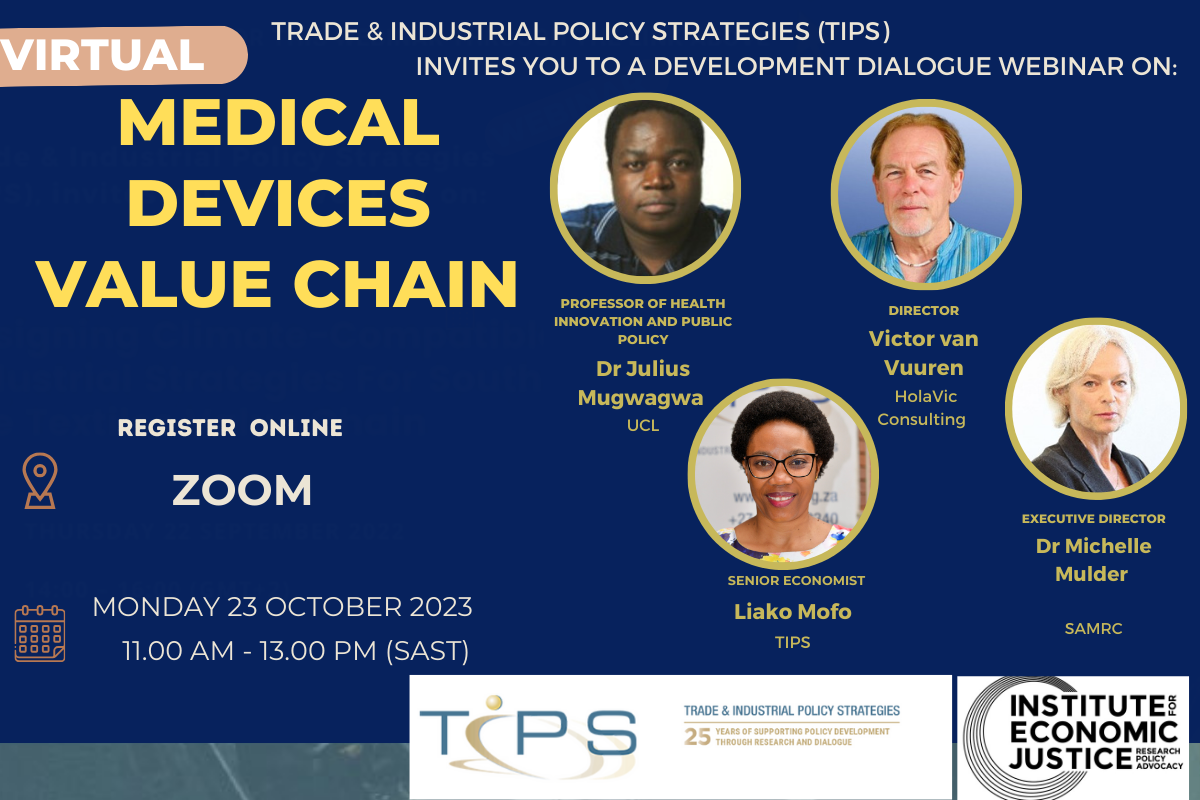
Medical Devices Value Chain
Monday 23 October 2023 at 11:00 AM – 13:00 PM.
11:00 Opening and welcome by Moderator: Dr Michelle Mulder (SAMRC)
11:10 – 12:20 Presentations and discussion:
- Dr Julius Mugwagwa (STEaPP) (University College London) – Presenting the IEJ Research Paper on Localising Medical Manufacturing in Africa
- Liako Mofo (TIPS) – Presenting on the South African Medical Devices Masterplan – Value Chain Analysis Study
- Victor van Vuuren (HolaVic) – Discussant: Insights from Manufacturers and Industry
12:20 – 12:50 Discussion
12:50 – 13:00 Closure
Presentations
Victor van Vuuren (HolaVic) - Medical devices
Dr Julius Mubwagwu (STEaPP) (University College of London) - Localisation of medical manufacturing in Africa
Media
Regulation and certification remain key for medical devices manufacturing in Africa - Schalk Burger, Engineering News 24 August 2023
Research
Localisation of medical manufacturing in Africa - Institute for Economic Justice November 2022
Background
South Africa is a large procurer of medical devices and pharmaceutical projects, with a well- established health care system and network. The COVID-19 pandemic as well as supply-chain disruptions highlighted the need to have domestic capacity in producing medical products. Further, building on the established demand for this sector, localisation of medical products would strengthen industrial capacity, create employment and reduce trade deficits.
This Development Dialogue will engage on the latest evidence for the development of domestic and Africa-wide capacity in the production of medical devices and products.
The Development Dialogue draws on recent TIPS research on the medical devices value chain in South Africa, IEJ research on localising medical manufacturing in Africa, and insights from the current process to develop a South African medical devices masterplan.
About the Speakers
Moderator
Dr Michelle Mulder is Executive Director in Grants, Innovation and Product Development at the South African Medical Research Council. She has a doctorate in Medical Microbiology from the University of Cape Town and has post-doctoral experience in a start-up biotechnology company emanating from the University of Cambridge (UK). She has consulted extensively in technology innovation and has been involved for the last 18 years in the strategic management and commercialisation of the SAMRC’s intellectual property and in capacity building in these areas in Southern and East Africa. She currently serves as a board member of two SAMRC-linked companies and is a member of the NHLS Research and Innovation Committee.
Presenters
Liako Mofo is a senior economist at TIPS. She holds a master’s degree in development economics from the University of Sussex, United Kingdom and has more than 16 years of experience in economic research, policy development and analysis, development of national strategic development plans, sector-specific investment plans and project cycle management in the public sector, and development in the regional and international context.
Dr Julius Mugwagwa is an Associate Professor of Health Innovation and Public Policy UCL STEaPP – Science Technology Engineering and Public Policy, University College London (UCL). His specialties and interests are local and global health; innovation systems; funding and governance of science, technology and innovation; health system strengthening; pharmaceutical and biotech sectors; cross-national technology governance; policy analysis; and project management.
Victor van Vuuren is Director: HolaVic Consulting (Pty) Ltd consulting globally. After completing a law degree Victor started his working career at the South African Department of Justice. Thereafter he moved into the private sector as a corporate legal advisor and human resources director at executive level in large corporates. Victor later helped establish a unified South African business federation, Business Unity South Africa, and was appointed as the first Chief Operations Officer.
For more information, please contact TIPS via email at: daphney@tips.org.za
TIPS Dialogues bring together academics, policymakers, civil society organisations, workers,
and practitioners to discuss important issues and share ideas on industrial policy.
TIPS is partnering with the Department of Trade Industry and Competition (the dtic)
and the Institute of Economic Justice (IEJ) which will co-host the seminar.
- Date Monday, 23 October 2023
- Time 11:00-13:00
- Venue Online via Zoom
Presentations
Lesego Moshikaro-Amani (TIPS) - Paving the path for a local battery industry in South Africa
Kgashane Mohale (IDC) - Battery value chain - IDC segmental approach (Slide)
Media
Media article: Battery industry set to boom - Business Times (Sunday Times) 22 October 2023
Media article: SMMEs can enter the battery energy value chain - Vutivi Business News 19 October 2023
Media article: Opportunities, challenges for South Africa in LIB, VRFB industries - Engineering News 18 October 2023
Research
Report: Opportunities to develop the lithium-ion battery (LIB) battery value chain in South Africa (2021) - Gaylor Montmasson Clair, Lesego Moshikaro and Lerato Monaisa (TIPS)
Policy Brief : Opportunities to develop the lithium-ion battery value chain in South Africa (2021) - Gaylor Montmasson Clair, Lesego Moshikaro and Lerato Monaisa (TIPS)
Report: Localising vanadium battery production for South Africa's energy security (2023) - Lesego Moshikaro and Lebogang Pheto (TIPS)
Policy Brief: A review of vanadium redox flow battery (VRFB) market demand and costs - Lesego Moshikaro (TIPS)
Background
The demand for battery energy storage systems (BESS) is on the rise in various sectors, including stationary applications and transportation. BESS plays a critical role in advancing the transition towards decarbonisation. In addition, battery storage systems are pivotal in seamlessly integrating renewable energy sources into the energy landscape. The increasing demand for batteries and their constituent minerals stems from the global push to decarbonise the automotive industry and ensure a reliable energy supply through renewables coupled with energy storage.
South Africa's large production and reserves of battery materials make it well-positioned to actively participate in the battery value chain. Developing a local battery value chain presents numerous economic opportunities for South Africa. There is a notable trend where batteries are predominantly consumed in the regions where they are manufactured. This is evident in the automotive industry and in countries' strategic investments in battery value chains to ensure their energy supply security. South Africa has the minerals and a market for batteries, but it's essential to stress the need for support in advancing both market development and the growth of industrial capacity for battery production.
Given this, the question arises: how can the country effectively engage in this value chain and contribute value to upstream activities within the value chain? TIPS research delves into this issue, focusing on the beneficiation processes these minerals can undergo to support the growth of battery industries, emphasising local capabilities throughout the value chain and offering recommendations on areas in which the country can competitively engage. The report also explores ways in which industrial policy can play a more substantial role in supporting emerging and high-tech industries, and how South Africa can establish a thriving local battery industry, underscoring the significance of sustaining demand.
About the Speakers
Moderator
Gaylor Montmasson-Clair is a Senior Economist at Trade & Industrial Policy Strategies (TIPS). He leads TIPS's work on sustainability and just transition. He is the Facilitator for the South African Renewable Energy Masterplan (SAREM), the industrialisation plan for South Africa’s renewable energy value chain.
Presenters
Lesego Moshikaro-Amani is Senior Economist at TIPS. Her expertise lies in industrial policy, battery energy storage value chains and the emerging sector of new energy vehicles (NEVs) in South Africa, including a strong emphasis on skill development within the NEV industry. Other areas of focus include skills development for industry and promoting employment.
Mikhail Nikomarov is an entrepreneur and African energy leader committed to resolving the continent’s electricity shortage. He co-founded Bushveld Energy to provide large-scale energy storage solutions across the African continent. The company develops energy storage projects and is also localising manufacturing of vanadium redox flow batteries in South Africa. Mikhail also serves as the Chairman of the South African Energy Storage Association (SAESA) and chairs the Energy Storage Committee for Vanitec, the global organisation of vanadium producers.
Kgashane Mohale is Senior Industry Specialist: Industrial Development leading in Innovation and Strategy at the Industrial Development Corporation of South Africa Ltd (IDC). He has experience in leadership, strategy design and execution, manufacturing and production management, business improvement, consulting, entrepreneurship, business development, commercial and engineering from various organisations. He currently develops strategies and investment products for IDC to develop and invest in new or priority sectors/value chains like the battery value chain – from mining through chemical and components, cell manufacturing and application and renewable energy localisation, focusing on wind and solar.
Ian de Vries is both CEO and CTO at Balancell, a technology startup. He leads on technology, hardware and software development, battery electromechanical integration, cell manufacturer selection, battery design, overall IoT software system architecture, including data flow, data structures, and battery data analysis. He has expertise in cell chemistry, battery management algorithms, product design to meet the highest safety standards and insights into the next generation needed for IoT software platform system architecture, data structures, and predictive algorithms.
For more information, please contact TIPS via email at: natasha@tips.org.za
TIPS Dialogues bring together academics, policymakers, civil society organisations, workers, and practitioners
to discuss important issues and share ideas on industrial policy.
TIPS is partnering with the Department of Trade Industry and Competition (the dtic).
- Date Wednesday, 18 October 2023
- Venue Hybrid