
- You are here:
-
Home

-
Events
- Development Dialogue Seminars


Press release: Unpacking the Just Transition in practice
Article:TIPS says broader, engaged development approaches needed to realise just transition projects (Marleny Arnoldi, Engineering News 25 March 2022)
Background
Development institutions tend to work according to an established framework, which helps practitioners and funders structure and plan their actions. This traditional model is based on empirical observations and on the ground experience of how project development and support policy work in practice. Key steps include:
- defining the problem and agenda setting;
- defining the vision and objectives of the strategy;
- identifying and selecting options, and implementing actions;
- monitoring, reporting, evaluation and policy adaptation.
The above cycle describes an idealised process, which differs from "real-life" processes. Steps are sometimes taken in parallel, and within one cycle not all steps may be covered completely. Recent examination of just transition projects and project development cycles suggest that the characteristics of such projects and their development may require an expanded or amended toolbox of actions, funding and sequencing.
For example, just transition projects require expanded participatory processes. Activities to support meaningful participation may thus need to be undertaken and funded to ensure participating workers or communities are able to engage both at a substantive as well as a process level. Another example is that environmental and green solutions sought by just transition project developers may require the inclusion of an expanded view of beneficiaries, given that environmental systems (such as water sheds) do not adhere to political or community boundaries. A final example is that just transition project developers will most likely require a range of funders to become involved in the project development cycle earlier than in traditional project finance. This idea of financial sector players making deals as opposed to buying deals will require additions to the existing project development and policy support toolbox.
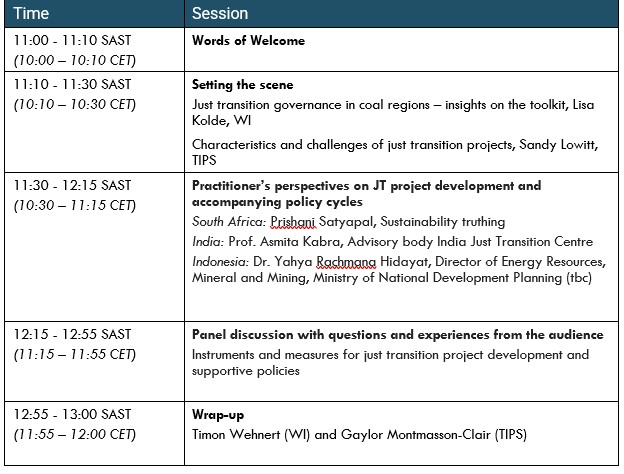
The webinar investigates how different countries deal with these emerging issues. In particular, the following questions will be addressed: Does participatory planning call for different policy instruments and mechanisms as well as a different policy cycle? Do just transition projects require different financial support mechanisms and instruments at different times to traditional projects? How is the scope of just transition projects (especially those seeking to address environmental degradation) different from traditional projects and what instruments, mechanisms and policy support measures can be developed.
Outline of the event
Date: 24 March
Organisations: Trade & Industrial Policy Strategies (TIPS) and Wuppertal Institute für Climate, Environment and Energy (WI)
Enquiries: rozale@tips.org.za

- Date Thursday, 24 March 2022
- Venue Zoom meeting
- For enquiries or to register please contact TIPS and Wuppertal Institute für Climate, Environment and Energy
SME Green Economy I-Go Initiative Project (Mbali Moroe: Project Manager, National Cleaner Production Centre of South Africa)
Green Economy Tracker
Online at Green Economy Tracker:
Media
Press release: Is South Africa on track in terms of its Green Economy Recovery objectives
Article: South Africa has strong green economy policies, but implementation a challenge (Marleny Arnoldi, Engineering News 17 February 2021)
This webinar aims to unpack South Africa's recovery efforts from a green economy perspective. It will notably feature the Green Economy Tracker developed by the Green Economy Coalition. It is the first of a series of four events in 2022 that will discuss South Africa's road to building back better, fairer and greener. Stay tuned and be part of South Africa's green recovery!
Programme
- Gaylor Montmasson-Clair, Senior Economist, Trade & Industrial Policy Strategies (TIPS)
14:30 - 14:50 Tracking South Africa's road to a green recovery
for Economic Justice (IEJ)
National Cleaner Production Centre of South Africa (NCPC-SA)
About the facilitator

- Date Tuesday, 15 February 2022
- Venue Zoom
<iframe width="560" height="315" src="/
" title="YouTube video player" frameborder="0" allow="accelerometer; autoplay; clipboard-write; encrypted-media; gyroscope; picture-in-picture" allowfullscreen></iframe>Overview
This webinar, organised in partnership with Trade and Industrial Policy Strategies (TIPS), will provide participants with a first look at findings from the International Institute for Sustainable Development (IISD) report South Africa's Energy Fiscal Policies: An inventory of subsidies, taxes and policies impacting the energy transition, presenting key takeaways and recommendations.
The report explores the extent to which South Africa's current energy fiscal policies are aligned with its goal to develop a robust domestic energy system that can provide low-carbon energy at a fair cost to all. It provides clear recommendations for the government to align its fiscal energy policies with its climate and energy objectives.
Through a panel discussion and a Q&A session, participants will be encouraged to engage in a debate on carbon tax, bailouts, and what international moves to phase out fossil fuel financing and oil and gas exploration mean for South Africa.
Key questions
- Exemptions to the carbon tax need to be removed - carbon tax needs to internalise the social and environmental cost of the energy system, but with practical considerations on the social impacts and the impact on Eskom's finances.
- Bailouts - although we cannot allow the energy system to fail, how do we make the sector sustainable and ensure that bailout funds are enabling a transition rather than inhibiting it?
- What do international moves around phasing out fossil fuel subsidies and oil and gas exploration mean for SA's energy sector?
- Is the tax system doing enough to take account of external costs in energy pricing?
AGENDA
| 11:00 | Welcome from the moderator Richard Bridle, Senior Policy Advisor, IISD |
| 11:05 | Opening remarks Sharlin Hemraj, Director: Environment and Fuel Taxes, National Treasury |
| 11:15 | Launching USD report "South Africa's Energy Fiscal Policies" Chido Muzondo, Policy Advisor, IISD |
| 11:25 | Panel discussion • Gaylor Montmasson-Clair, Senior Economist: Sustainable Growth, Trade and Industrial Policy Strategies • Jessie Burton, Senior Associate, E3G (Third Generation Environmentalism) |
| 12:25 | Q&A |
| 13:00 | Close |
Registration
Register online: https://us06web.zoom.us/webinar/register/WN_5yhGna3LQYicnioMFvzAHg
- Date Monday, 31 January 2022
- Time 11:00-13:00
- Venue Webinar
- For enquiries or to register please contact Register online: See link on page
This Development Dialogue webinar aims to provide a platform to hear from and engage with peope from Mpumalanga. It aims to unpack key concerns, aspirations, visions and the needs of people in Mpumalanga, focusing on what is required to shift the status quo and make a positive change in employment, poverty, energy, health, and the environment.
This is the third event of a series. It forms part of a larger project, funded by UK PACT, that intends to facilitate the co-development of a coherent just transition plan for affected communities in Mpumalanga, with a particular focus on Emalahleni and Steve Tshwete.
The specific aim of this event is to unpack what is meant by public participation and how it can be improved, through existing and/or new platforms. What would facilitate the co-development of solutions to a just transition, enabling communities and workers to be empowered and creating a space for local voices to be heard?
Programme
14:00 - 14:05: Welcome and introduction, Peta Wolpe
14:05 - 14:25: Why participatory justice matters. Key principles and interventions. Gaylor Montmasson-Clair, Senior Economist, TIPS
14:25 - 15:00: Sharing success, challenges and proposals for better engagement: What are the key interventions that would foster improved public participation?
- Matshepiso Makhabane, CEO, Green Business College and Coordinator, Gender and Energy Network of South Africa (GENSA)
- Hameda Deedat, Executive Director, National Labour and Economic Development Institute (NALEDI)
- Michael Nkosi, Local Economic Development Department, Steve Tshwete Local Municipality
- Matthews Hlabane, National Organizer of the Right to Say No in South Africa and environmental justice activist in Emalahleni

- Date Tuesday, 30 November 2021
- Venue Zoom Meeting
- Organisation Trade & Industrial Policy Strategies (TIPS) and the National Labour and Economic Institute (NALEDI), supported by groundWork and Peta Wolpe

Presentation: Financial Stakeholder Communication, Awareness and Outreach - (Nicole Martens, Martens Impact Advisory)
Research Report: TIPS Just Transition Finance Roadmap Workstream: Communication, Awareness & Outreach - (Nicole Martens, Martens Impact Advisory)
Presentation: Insights for South africa's Just transition Finance Roadmap: Nexus of Project Needs and Financing Response - (Chantal Naidoo, Rabia Transitions Initiative)
Research Report: Insights for South Africa's Just transition Finance Roadmap: Nexus of Project Needs and Financing Response - (Chantal Naidoo, Rabia Transitions Initiative)
Presentation: Scaling Community JT Projects Towards a Just Transition (Fumani Mthembi, Knowledge Pele)
Research Report: Scaling the Just Transition for Community-based and Community-placed projects - Fumani Mthembi (Knowledge Pele)
Media
Press release: Financing the Just Transition puts a spotlight on financial institutions
Article: Ramaphosa to chair inter-Ministerial committee to oversee R131bn just transition offer (Terence Creamer, Engineering News 25 November 2021)
Article: Just Transition: SA's battle for green power accreditation (Thuletho Zwane, City Press 28 November 2021)
Background
The roadmap towards financing a just transition seeks to make explicit the link between actions in the financial system and the realisation of broader national goals of sustainability and socio-economic development. The country’s roadmap will be a function of its national context and climate action ambitions, and aims to develop a long-term systemic plan to enhance the ability of the financial ecosystem to mainstream environmental, social, governance (ESG) factors; sustainable development goals (SDGs); and just transition goals into decision-making and capital allocation. In South Africa, an additional fundamental aim of the roadmap will be to mobilise offshore public sector funding and private local capital for such investment, given the limited fiscal space.
This seminar will discuss the bottom-up approach used in the research process, what could work within the current financial system, and where changes to the financial ecosystem are needed to effectively support a just transition. Research commissioned by TIPS will be presented on topics that help to unpack the finance roadmap and provide insights on scale and replicability of projects, financial instruments, social indicators, and corporate awareness, outreach and communication.

- Date Thursday, 25 November 2021
- Venue Zoom
Presentations
Ulrich Harmes-Liedtke - Partner at Mesopartner
Presentation: Global trends in Quality Infrastructure
Eduardo Trajano Gadret - Researcher-Technologist in Metrology and Qualith at INMENTO
Presentation: Quality Infrastructure in Brazil
Martin Chesire - Chief Executive Officer at Kenya Accreditation Service (KENAS)
Presentation: Quality Infrastructure in Kenya
Programme
14:00: Facilitator opens the seminar: Saul Levin
14:05: Opening remarks Tshenge Demana: Quality Infrastructure in support of industrial development
14:10-14:20 Global trends in Quality Infrastructure: Ulrich Harmes-Liedtke
14:20-14:45 Presentations on international experience in Quality Infrastructure institutional role:
- Eduardo Trajano Gadret: QI in Brazil
- Martin Chesire: QI in Kenya
14:45-15:15 Discussion and engagement on how experiences of QI development could enrich South Africa in the context of Post-COVID-19 economic recovery
15:15 Closure
Background
South Africa’s industrial policy aims to bring about a change in the structure of the economy to put the economy on a more inclusive, industrialised and sustainable path. Quality Infrastructure (QI) institutions (SABS, NMISA, NRCS, and SANAS) are part and parcel of industrial policy measures, with international experience seeing a correlation between levels of economic development and robustness or effectiveness of a country’s QI. With the QI system evolving globally and an improved understanding of its critical role in industrial policy, consideration needs to be given to its role in post-COVID-19 economic recovery plans.
For more about the Institutional alignment of Quality Infrastructure in South Africa and links to case studies on QI in Australia, Brazil, Kenya and the Republic of Korea, go to Quality Infrastructure case studies.
About the Speakers
Eduardo Trajano Gadret is Researcher-Technologist in Metrology and Quality at INMETRO
Martin Chesire is Chief Executive Officer at Kenya Accreditation Service (KENAS)
Saul Levin is the Executive Director of TIPS
Tshenge Demana is a Chief Director in the Department of Trade, Industry and Competition
Ulrich Harmes-Liedtke is a partner at Mesopartner
RSVP by email: daphney@tips.org.za to confirm attendance
Zoom meeting details
Register online
- Date Monday, 25 October 2021
- Venue Zoom